



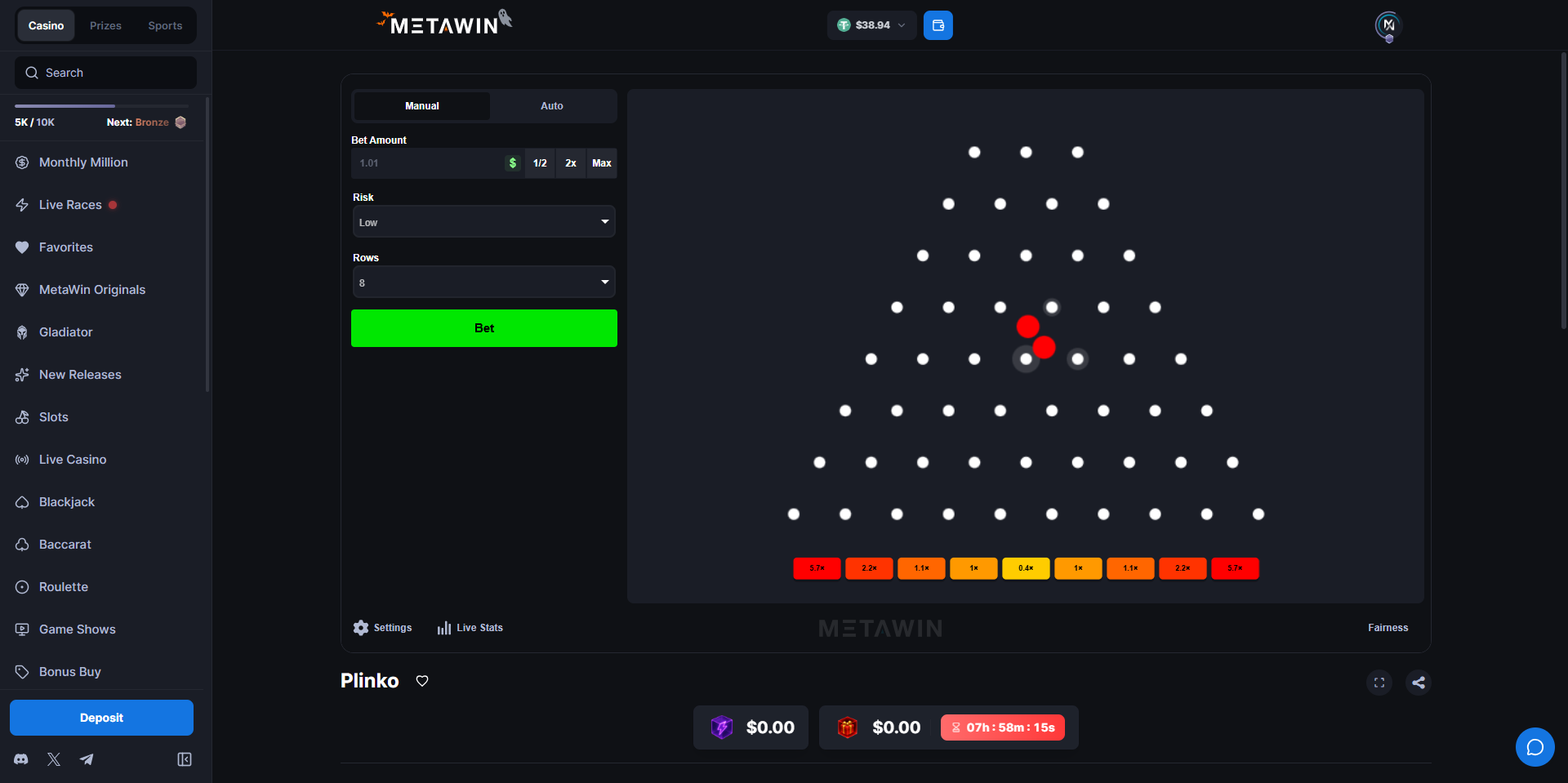
Plinko drops a ball through rows of pegs into a line of slots at the bottom, each marked with the multiplier it pays. How often the ball reaches each slot appears nowhere on the board, though some basic maths works it out and also explains why the middle gets so much traffic.
Taken slot by slot, those chances are the Plinko odds, and multiplying each one by its slot's payout feeds into Plinko RTP, the average share of money wagered that returns to players.
We'll use MetaWin Plinko, our in-house board, to explain the odds and the RTP with actual figures and worked examples. Its 97% RTP is a long-run average rather than a promise for your session, since a short run of drops can land far from it in either direction. If the buttons are still new to you, our how to play Plinko guide covers those before we get into the numbers.
How do Plinko odds work?
Whenever the ball hits a peg on its way down, it's as likely to go left as right, and nothing about earlier bounces changes that. By the time it reaches the bottom, the order of those bounces no longer matters, so the slot it lands in depends on how many "rights" it took.
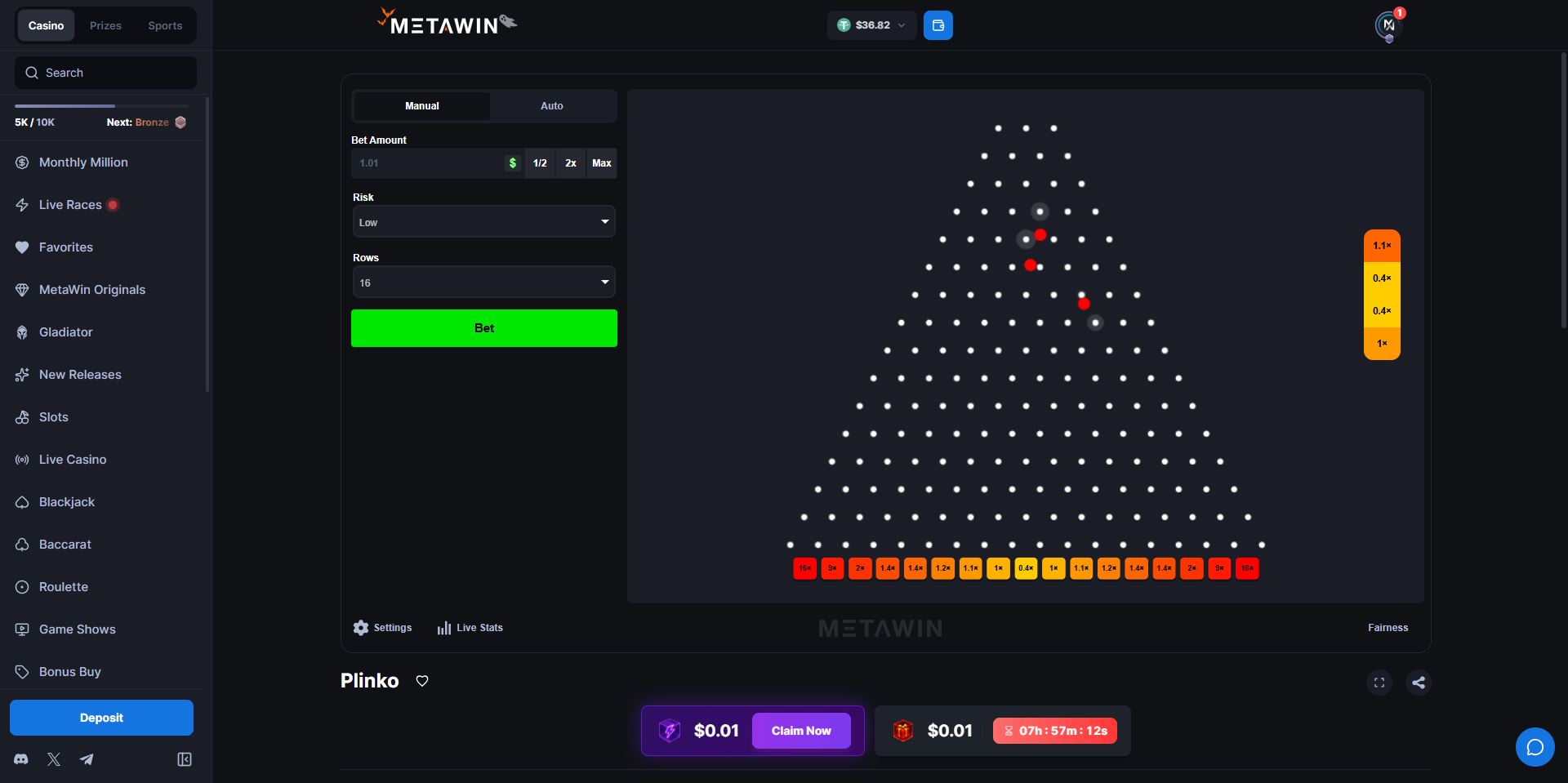
With that rule in place, the Plinko maths gets lopsided quickly, because only one sequence, all lefts or all rights, reaches an edge. Meanwhile, the centre accepts any mix with equal lefts and rights, and on a 16-row board those mixes run into the thousands. So the middle collects far more drops because more paths lead there.
More rows means more paths and slots. On 8 rows, the ball can finish in 9 slots via 256 paths. At 12 rows, that grows to 13 slots and 4,096 paths, and at 16 rows to 17 slots and 65,536 paths.
Even as the paths multiply, the centre keeps the biggest share. In Plinko probability terms, that comes to 27.3% on 8 rows, 22.6% on 12 and 19.6% on 16. Mathematicians call this pattern a binomial distribution, which on a Plinko board takes a rough bell shape, high in the middle and thin at both ends.
What are the odds of landing each slot?
From a player's seat, any slot comes down to two questions, how often the ball finds it and what it pays when it does. Our Plinko probability chart answers both for MetaWin Plinko on 16 rows at High risk. Its chances cover one slot at a time, so double them for either of a matching pair, except at the centre, which appears only once. Features, controls and gameplay all have a home in our MetaWin Plinko review, which leaves this Plinko odds chart free for the numbers.
| Slot (from either edge) | Chance per drop (each side) | Roughly 1 in... | High-risk multiplier |
|---|---|---|---|
| Edge (slot 1) | 0.0015% | 65,536 | 1,000x |
| Slot 2 | 0.0244% | 4,096 | 130x |
| Slot 3 | 0.18% | 546 | 25x |
| Slot 4 | 0.85% | 117 | 8.4x |
| Slot 5 | 2.78% | 36 | 3.9x |
| Slot 6 | 6.67% | 15 | 2x |
| Slot 7 | 12.22% | 8 | 0.2x |
| Slot 8 | 17.46% | 6 | 0.2x |
| Centre (slot 9) | 19.64% | 5 | 0.2x |
Look at where the ball lands most, and you'll find the cheapest slots on the board, the centre and its two nearest neighbours on each side. Between them, those five collect close to 79% of drops, and none pays more than 0.2x. So roughly four drops in five give you back less than you put in, even though every drop pays something.
What is Plinko RTP?
Four losing drops out of five at High risk may sound like a poor deal, yet MetaWin Plinko's average return is 97 cents per dollar wagered. Those rare trips towards the edges bring much larger payouts, and Plinko RTP accounts for them too. Short for return to player, it shows how much of everything staked comes back to players across a very large number of drops.
Our chart has both ingredients you need to work out the RTP yourself. Multiply what a slot pays by its chance, then repeat for all 17 slots and add up the results. Matching slots count separately. At the centre, a 0.2x payout with a 19.64% chance contributes about 0.039 to the total, while each 1,000x edge adds roughly 0.015. Across the board, those contributions come to around 0.97, or 97% RTP.
In money, picture 1,000 drops at $10 each, which puts $10,000 through the board. Your expected total Plinko payout is $9,700, leaving a $300 cost, or 30 cents per drop.
Real sessions rarely land on that number. One 130x hit returns $1,300 on that stake, while every 0.2x result returns just $2. Where the ball actually goes in your run can push the total well above or below the $9,700 expectation.

Author's Thoughts
Matija Antic
I think of the 3% as the price of every drop. Rows and risk change how bumpy the ride feels, but that price stays exactly where it is.
RTP vs house edge: what's the difference?
RTP and house edge describe the same money from opposite ends. Players compare games by RTP, the part that comes back on average, while the house edge names the share the casino expects to retain over time.
Since together they make up 100%, the house edge equals whatever RTP leaves over. That makes a 97% Plinko RTP a Plinko house edge of 3%. For you as a player, that's an expected loss of 3% of everything wagered, including money you win and bet again. Our guide to dice odds and house edge works through a 2% edge on dice step by step, if you'd like the idea in more depth.
Do rows and risk levels change your odds?
Whenever you switch rows or risk, the board changes so visibly that it's easy to assume everything has changed with it. Rows do alter the Plinko odds, because each row count gives the slots a different set of probabilities. Risk keeps those chances as they are and changes the Plinko multipliers instead. Neither setting changes the game's 97% RTP.
On Low risk, most multipliers stay close to 1x, so there's less distance between an ordinary result and the biggest payout. At 16 rows, the top prize is 16x. High risk stretches that gap, with 1,000x at the edges and much smaller returns across the centre. Compare the same slot on either risk setting, and its chance hasn't moved, but its payout may have changed considerably.
So how often does a drop pay back at least your stake? Here's that hit rate across three row counts and all three risk levels on MetaWin Plinko.
| Rows | Low risk | Medium risk | High risk |
|---|---|---|---|
| 8 | 72.66% | 28.91% | 28.91% |
| 12 | 77.44% | 38.77% | 14.60% |
| 16 | 80.36% | 45.45% | 21.01% |
Slots paying exactly 1x count as a returned stake.
Higher risk means fewer drops break even or better on 12 and 16 rows, while on 8 rows, Medium and High share the same 28.91%. More rows don't follow one neat rule. They raise the top multiplier every time and lift the hit rate on Low and Medium, while High dips at 12 rows. So the biggest multiplier alone tells you very little about an ordinary drop. For more on how widely results can vary, our guide to what volatility means for players explains the idea through slots.
How often does Plinko hit 1,000x?
Out of every combination of rows and risk, only one puts 1,000x on the board, 16 rows at High risk. There, the Plinko odds of hitting either edge are 1 in 32,768 per drop. Smaller boards reach their edges more often, as the table shows, both on a single drop and across a run of 10,000.
| Rows | Either edge, one drop | At least one edge in 10,000 drops |
|---|---|---|
| 8 | 1 in 128 | ~100% |
| 12 | 1 in 2,048 | 99% |
| 16 (1,000x at High risk) | 1 in 32,768 | 26% |
On 16 rows at $1 a drop, a run of 10,000 means $10,000 wagered for about a 26% chance of at least one 1,000x return. Roughly three runs in four would miss it altogether, and a hit wouldn't guarantee a profit across the run. Before you commit a budget, the bankroll tips on our Plinko games page explain how to size your stakes.
Author's Thoughts
Matija Antic
A 1 in 32,768 shot is rarer than it looks on the board. If you're playing 16 rows on High for the 1,000x, plan your budget around the long run of small returns that comes first.
How do MetaWin's Plinko games compare on RTP?
Our hub carries numerous versions of this format, and while they share the same idea, they differ in areas like Plinko RTP and max win. Below, you can compare seven of them on the numbers that set them apart.

MetaWin Plinko
MetaWin Studios
MetaWin Original. Top multiplier on 16 rows at High risk.

Plinko - World Cup Edition
MetaWin Studios
MetaWin Original. Top multiplier on Insane risk.

Plinko Poker
I3soft
Poker hands built during drops pay Bonus Balls.

Plinko XY
BGaming
Exact RTP depends on your settings.

Plinko 2
BGaming
Exact RTP depends on your settings.

Plinko Empire
TaDa Gaming
Bonus wheel on Medium and High risk.

Pine Of Plinko 2
Print Studios
Slot with a Plinko bonus round.
Pure Plinko games in this selection cluster around 97%. Where a range appears, the game's info panel says the exact figure depends on how you play. Slots with a Plinko bonus round, such as Pine of Plinko 2, usually sit lower and work differently. This one pays through reels and win lines, and the Plinko board only comes into it during the bonus.
To check out titles from these providers yourself, you can play crypto Plinko at MetaWin and compare their info panels before your first drop.
Is Plinko rigged?
Fairness and profit are two separate questions in Plinko, and it helps to keep them apart. MetaWin Plinko is provably fair, so through the Fairness button you can confirm a drop wasn't altered after your bet, and our how to play Plinko guide shows each step. What fairness can't do is remove the 3% house edge, which stays the same on every drop.
Did You Know?
Long before Plinko, Victorian scientist Francis Galton built the Galton board, or bean machine, in the 1870s to show how random bounces pile up into a bell curve. Plinko still runs on the same maths, which sets the odds behind every paytable.


