


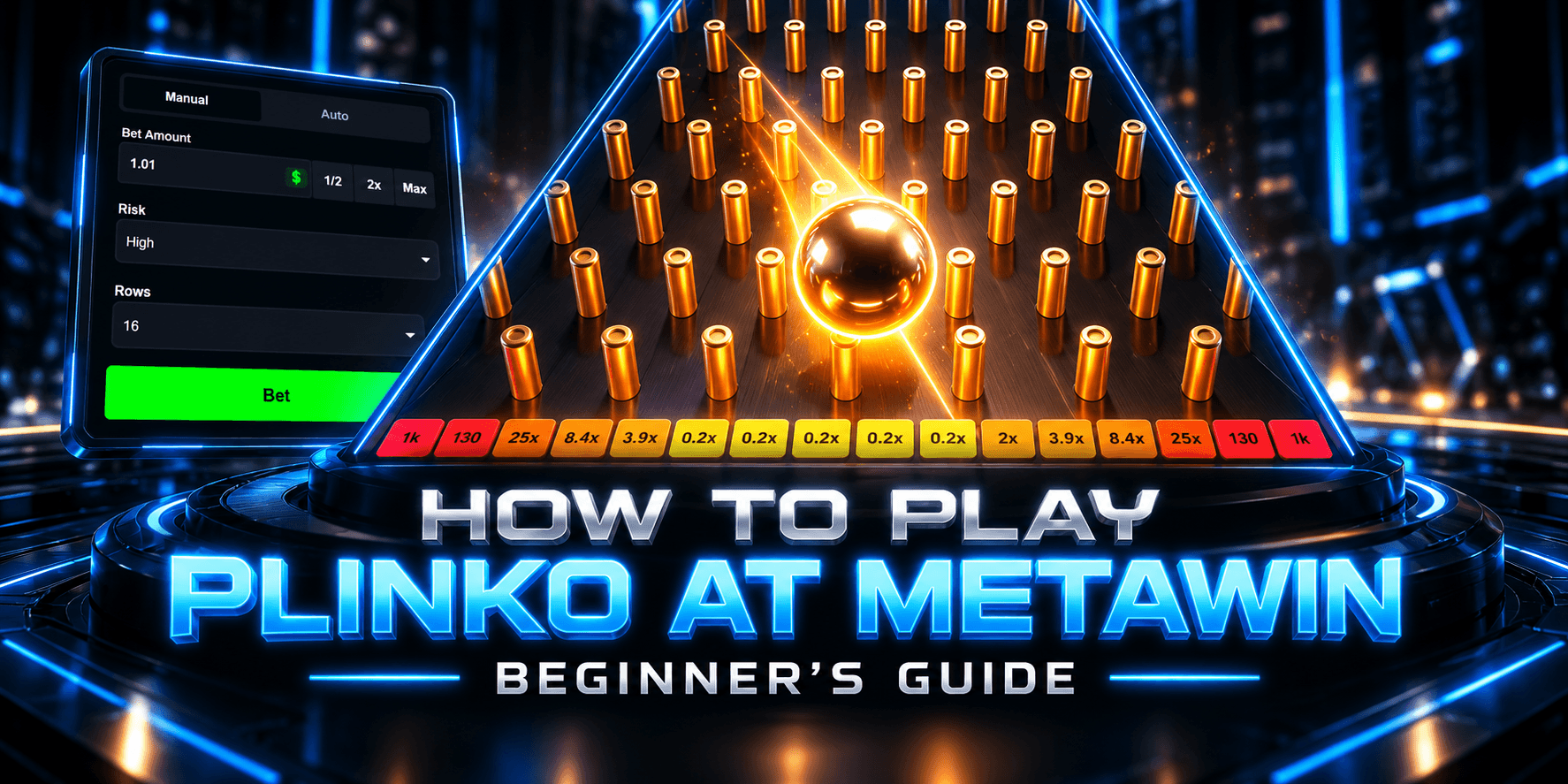
Plinko is a ball-drop casino game where you drop a ball through a triangular board of pegs, and the multiplier on the slot where it lands sets your return. Unlike poker or even Mines, it barely needs you at all, which makes it much closer to Crypto Dice. Before you press Bet, two settings get a say in what that return can look like.
Rows set the length of the ball's trip down the board, while risk changes what the slots beneath it pay. To explain how to play Plinko, we'll use MetaWin Plinko and show how those choices affect the results you can expect. Follow along, and you'll know how to set up your first drop, what the multipliers mean and why some slots are much harder to reach than others.
What is Plinko?
Plinko's first players never touched a screen when it debuted in 1983 on a TV show called The Price Is Right. Contestants released flat discs from the top of a large pegboard and watched them zigzag towards a row of cash prizes.
Online, the disc turned into a ball and the cash prizes into multipliers. Even the prize map flipped, with the biggest ones out at the edges instead of the middle.
Only the route to the slots survived the move unchanged. Pegs line up in rows that grow by one with every step down. In each row, the ball strikes a single peg, which sends it left or right with equal odds, and the Plinko game rules never favour either side.
Before each drop, you pick your stake, then choose anywhere from 8 to 16 rows and one of three risk levels: low, medium or high. More rows add more possible paths to the bottom, while risk reprices the slots and leaves every peg as it was.
Several Plinko titles from our lobby get their turn later in the guide. Until then, every number comes from MetaWin Plinko, which we developed in-house as a MetaWin Original, so you can only play it here at MetaWin Casino.
How do you play Plinko at MetaWin?
Now that we've covered the basics and where the game came from, here's how Plinko works in practice, from funds in your wallet to your first drop.
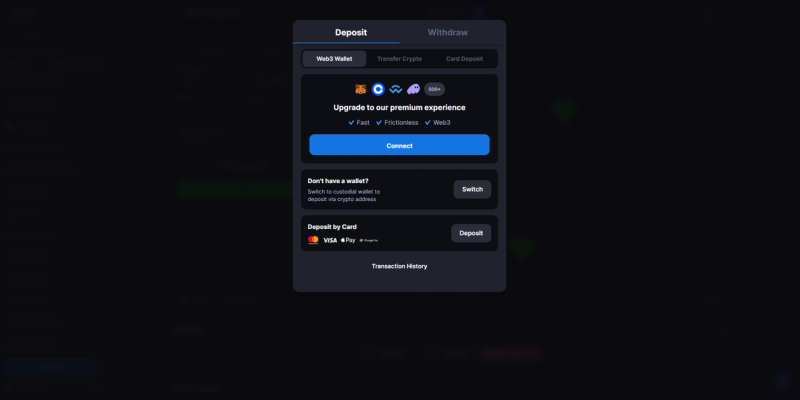
Step 1: Connect your wallet and deposit crypto
Press the blue Deposit button at the bottom of the left-hand menu, and the Cashier opens on Web3 Wallet, for wallets such as MetaMask or Phantom. Coins on an exchange go through Transfer Crypto instead, where an orange notice above the address names the only network it accepts. With no crypto yet, Card Deposit buys some with a card or a phone wallet.
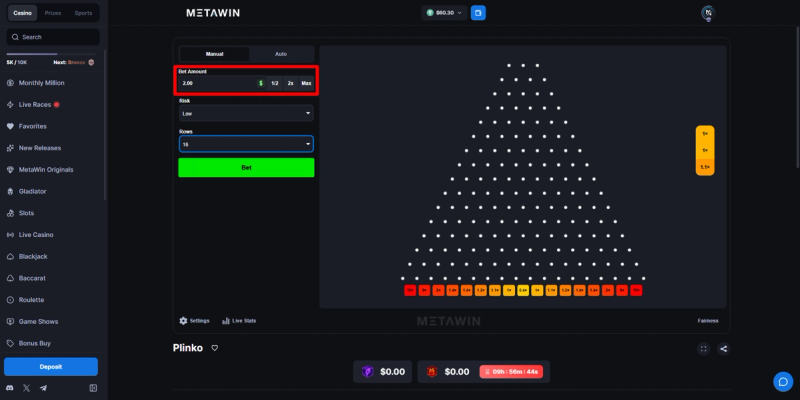
Step 2: Open MetaWin Plinko and set your bet
Our Plinko hub lets you play crypto Plinko at MetaWin on every board we carry, MetaWin Plinko included. Once the game loads, the controls run down a panel on the left. Type a stake into Bet Amount, or tap 1/2 and 2x beside it. They do exactly what their labels say. Manual, the tab at the top of the panel, should stay active, since it releases one ball per click of Bet.
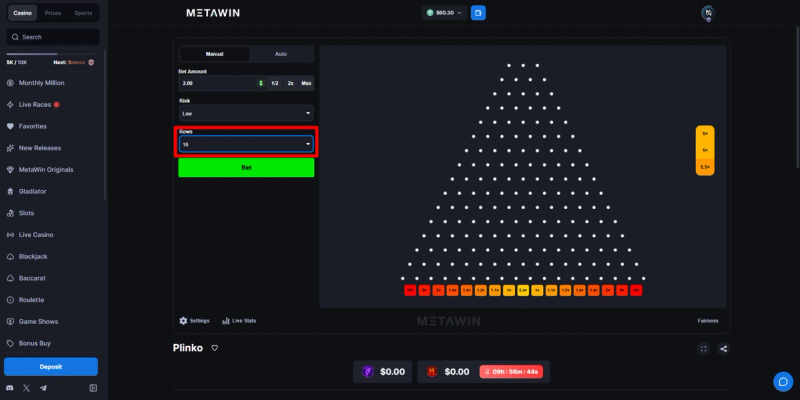
Step 3: Choose the number of rows
Rows is the lowest dropdown on the panel, right above the green Bet button, and it goes from 8 to 16. Every change redraws the board, one row of pegs and one slot more or fewer per step, so the new shape appears before any money moves.
Step 4: Choose your risk level
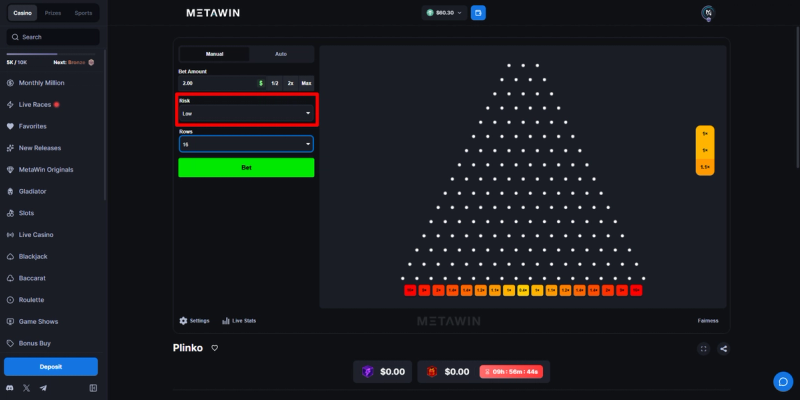
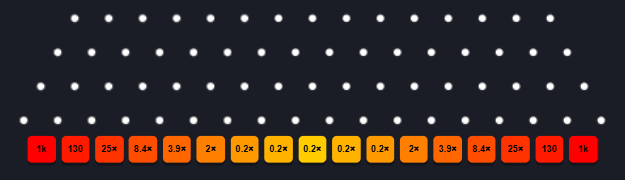
Just above Rows, the Risk dropdown offers three levels, from Low up to High. Switch between them at 16 rows and the two outer slots jump from 16x on Low to 1k on High, the board's shorthand for a 1,000x multiplier.
Step 5: Drop the ball, or queue several drops
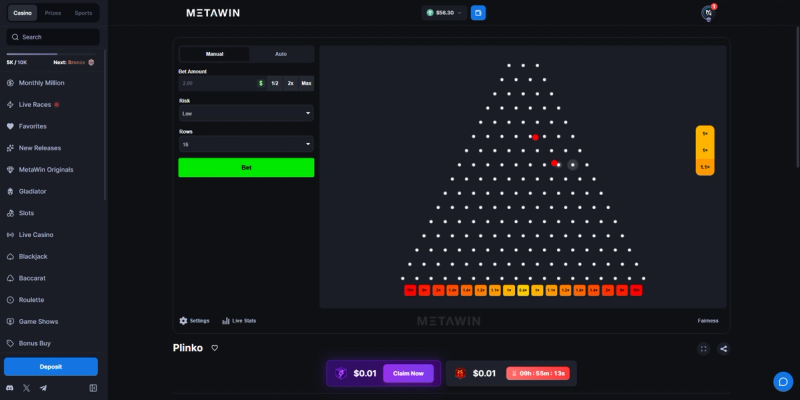
Bet works like a trigger you can press again and again. Each press places another bet at your selected stake, so several balls can bounce down together, and Bet Amount, Risk and Rows dim and stay locked until the last one lands. Every finished drop pays out at its slot's multiplier and adds a coloured tag to the column right of the board, latest at the top.
How do rows, risk and payouts work?
Results in the strip beside the board rarely come out even, and the paths into each slot explain why. Every peg is a coin toss for the ball, and a 16-row board means 16 tosses, which multiply out to 65,536 different paths, each as likely as the next. Those are the real Plinko odds, and every slot collects its share of them.
MetaWin Plinko payouts at 16 rows
| Slot | Odds per drop | Low | Medium | High |
|---|---|---|---|---|
| Edge | 1 in 32,768 | 16x | 100x | 1,000x |
| 2nd from edge | 1 in 2,048 | 9x | 40x | 130x |
| 3rd from edge | 1 in 273 | 2x | 10x | 25x |
| 4th from edge | 1 in 58 | 1.4x | 5x | 8.4x |
| 5th from edge | 1 in 18 | 1.4x | 2.9x | 3.9x |
| 6th from edge | 1 in 7.5 | 1.2x | 1.4x | 2x |
| 7th from edge | 1 in 4.1 | 1.1x | 1x | 0.2x |
| 8th from edge | 1 in 2.9 | 1x | 0.5x | 0.2x |
| Centre | 1 in 5.1 | 0.4x | 0.3x | 0.2x |
| Drops below 1x | 19.6% | 54.6% | 79% |
Each edge gets the smallest share possible, a single path where the ball goes the same way every time, so it catches one drop in 65,536, approximately 0.0015%. By contrast, 12,870 paths with eight lefts and eight rights in any order end in the centre, roughly one drop in five, or 19.6%. Such a gap in Plinko probability is why the biggest multipliers, up to 1,000x, go to the edges, since a board can only afford to pay big where the ball almost never goes.
Rows, the first of your two choices, stretch or squeeze that gap. The 8-row board gives the ball a mere 256 routes down, which brings an edge within reach about once in 256 drops, while 16 rows push the extremes far out.
Risk leaves the paths alone and moves the money instead. At 16 rows, the centre pays below 1x on every level, but higher risk drains more of the middle to load the edges, so about one drop in five returns less than your stake on Low, against nearly four in five on High. If that sounds familiar from slots, it's what volatility means for players, just on a peg board.
However wild the swings get, the Plinko rules attach a 3% house edge to every board you build. Weigh each slot's multiplier by how often the ball reaches it, and the average works out at 0.97 of every stake.

Author's Thoughts
Matija Antic
The edges are where the big numbers live, but the ball almost never goes there. Pick a risk level for the ride you want, not because you think it improves your odds.
Autoplay and beginner tips
Once a first drop feels familiar, the Auto tab next to Manual saves you the clicks. It keeps your current setup and adds one field, Number of bets, where 0, shown with an infinity sign, lets the run carry on until you stop it.
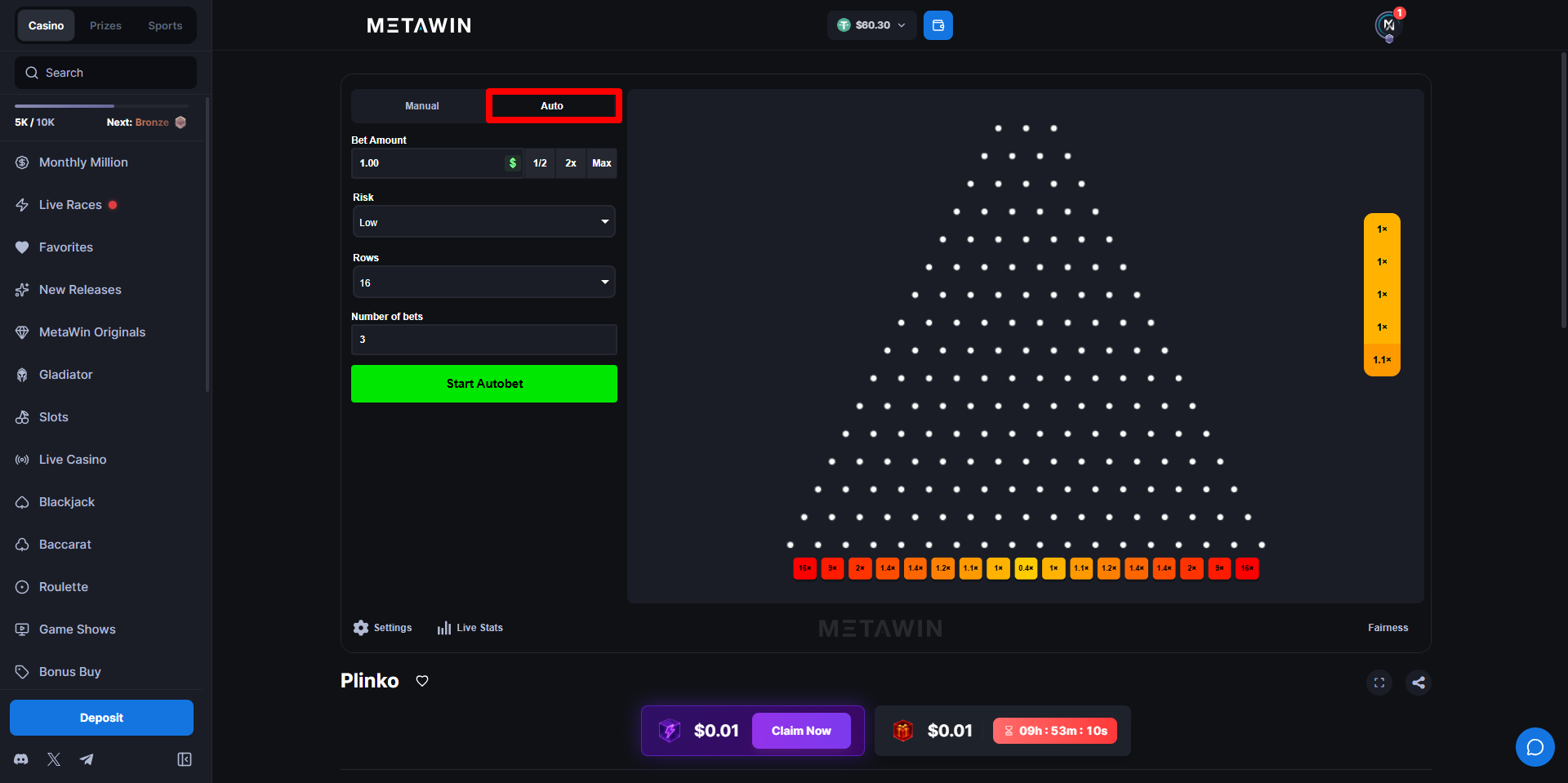
Auto has no stop-loss or stop-profit option, so the drop count is the only built-in limit. Multiply it by your stake for the most that run can wager, and 50 drops at $0.10 never put more than $5 in play. Live Stats, beside Settings under the panel, then shows your Wagered total and Profit as the balls land.
While you're still in the process of learning, Low risk on fewer rows keeps your best and worst slots closer together. A low mine count eases the start in a different way, with better odds of a safe pick, as you'll know if you've learned how to play Mines.
Aim simply doesn't exist here, because the provably fair seeds fix each path the instant you bet. After you get handy with the settings, keep in mind that whichever Plinko strategy you choose, none can get the 3% house edge out of the way or promise a profit.
Author's Thoughts
Matija Antic
Set a drop count before you start an Auto run. It's the only built-in limit, so treat it as your budget for the session.
How do you know a drop is fair?
If you'd like to check a drop after it's done, click Fairness in the bottom-right corner, right under the board. In there, your client seed and our server seed work as a pair, but you only see a hash of the server half while that pair is active. Hit Rotate Seed Pair, and the old server seed is yours to read, with a hash that lines up with the one you saw all along.
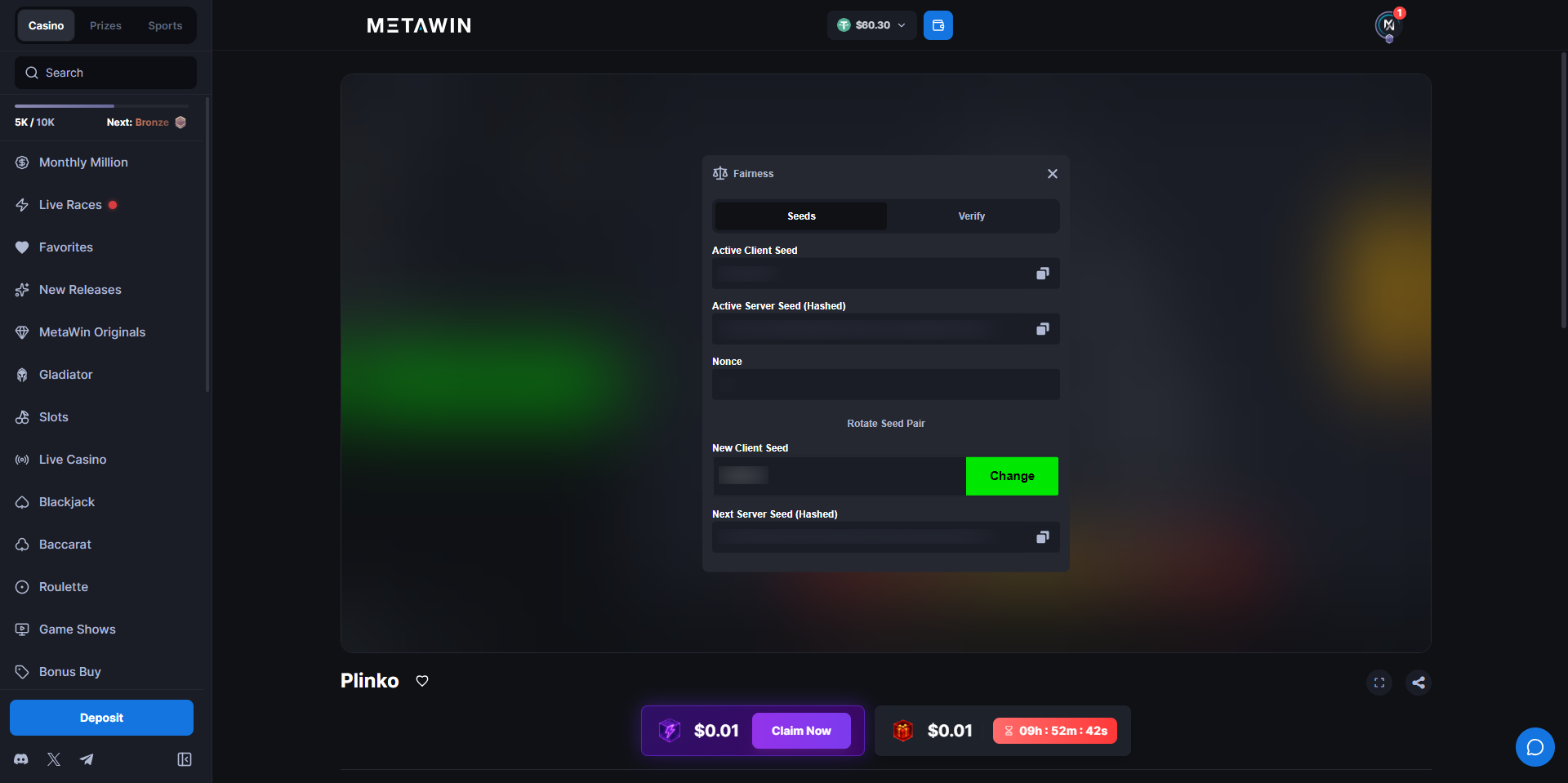
Copy both seeds into the Verify tab with that drop's nonce, then add the Risk and Rows you played on to check the result against the same board and payouts. The ball turns up in the very same slot. For a closer look and better understanding of how provably fair games work, check out the article in our guides section.
Which other Plinko games can you try at MetaWin?
Our board sticks to pegs and two settings and is probably the best Plinko for beginners, but a few titles in our lobby pile more on top.
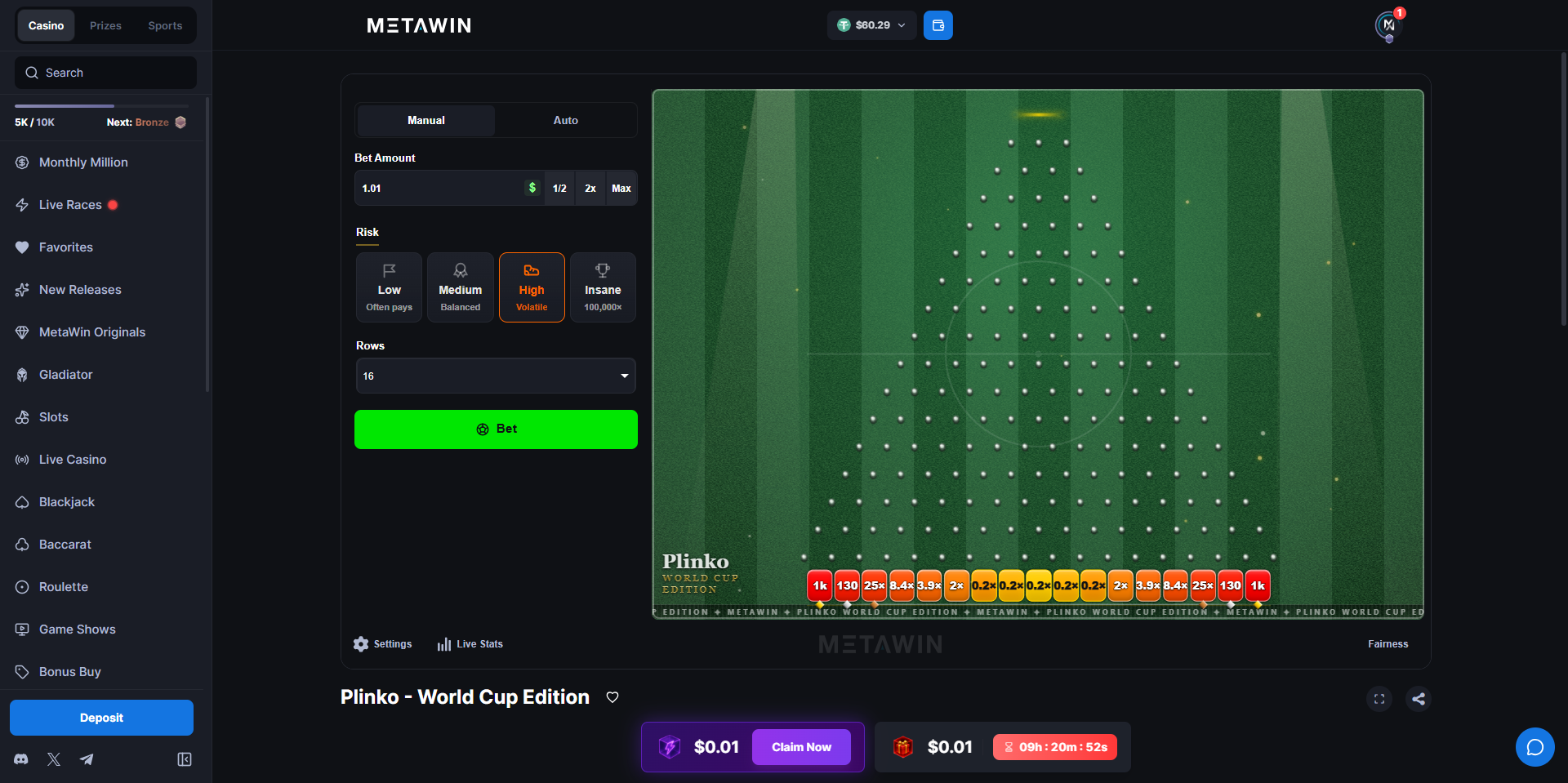
Plinko World Cup Edition keeps the classic layout on a football pitch, with an Insane mode that offers wins up to 100,000x.
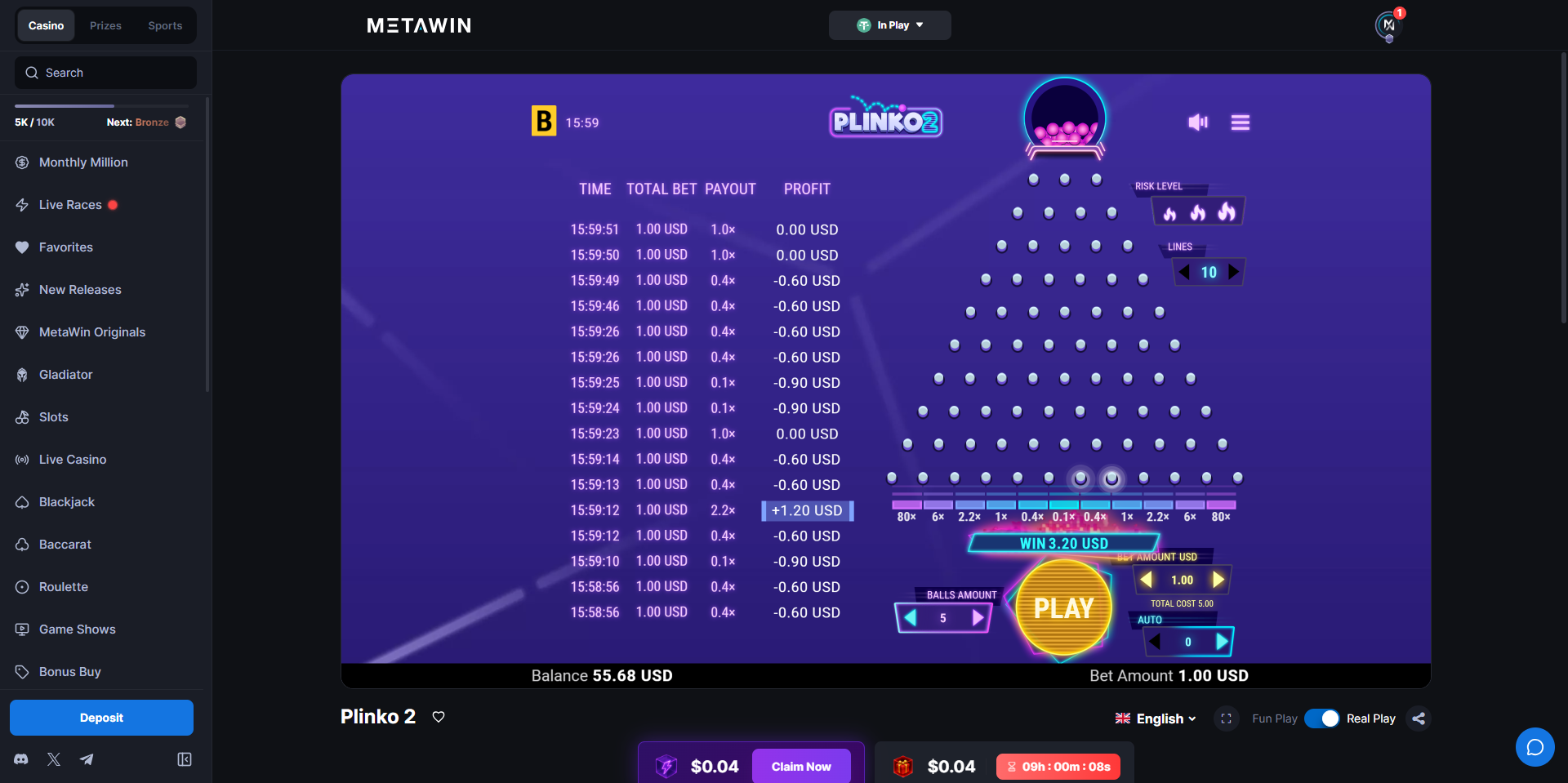
BGaming's Plinko 2 adds optional buy features, such as extra board multipliers and free drops. TaDa Gaming's Plinko Empire takes the board into an Egyptian temple, where a Lucky Roulette wheel adds bonus prizes on medium and high risk.
Print Studios strays furthest from the format with Pine of Plinko 2, a slot that saves Plinko for its bonus round. Our Plinko hub has the full line-up.

