



MetaWin Dice gives you control over how likely each bet is to win. Move the target one way and the win chance goes up. Move it the other way and the payout gets bigger.
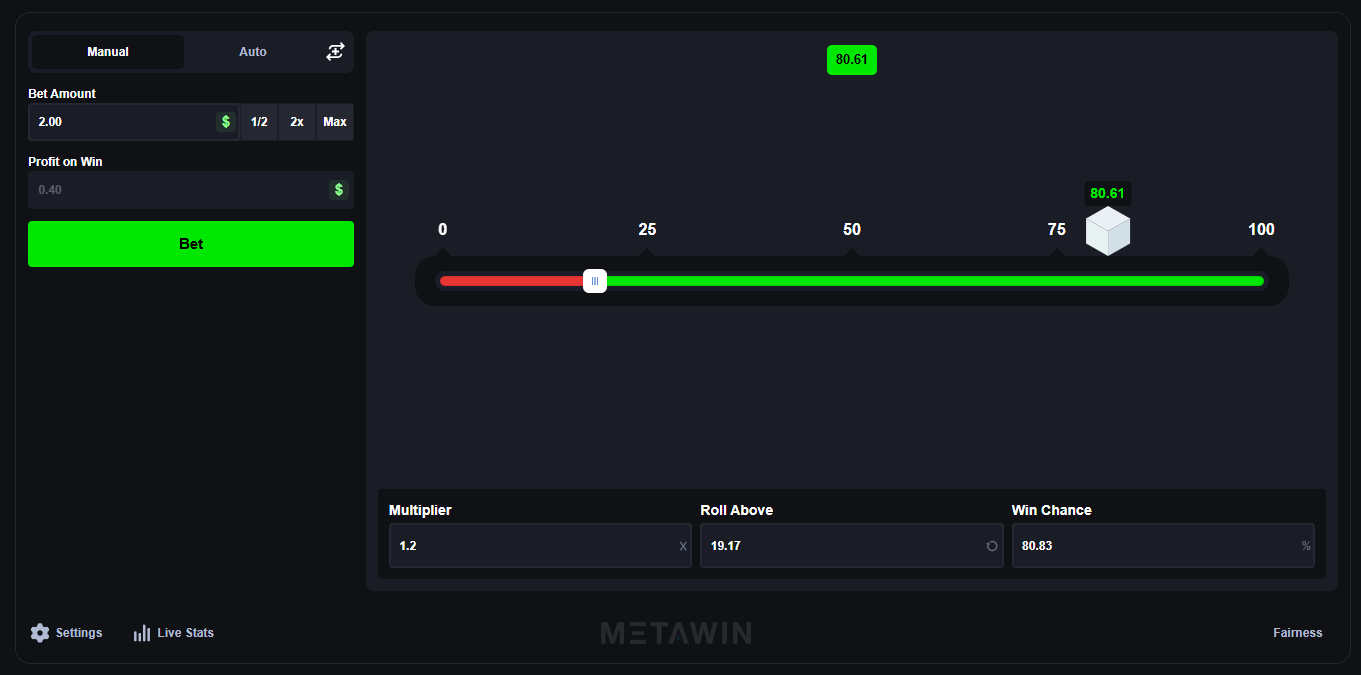
Your dice odds determine how likely the bet is to win and how large the payout should be. The dice house edge then takes a small percentage out of that theoretical payout.
At MetaWin, that edge is 3%, which gives the game a 97% RTP. We'll use those real figures throughout this guide to show how payouts are calculated, what different win chances pay, and exactly how much the house edge changes the return on every bet.
How do crypto dice odds work?
The basic rule behind crypto dice odds is straightforward. The more likely a bet is to win, the less it pays. The less likely it is, the higher the multiplier.
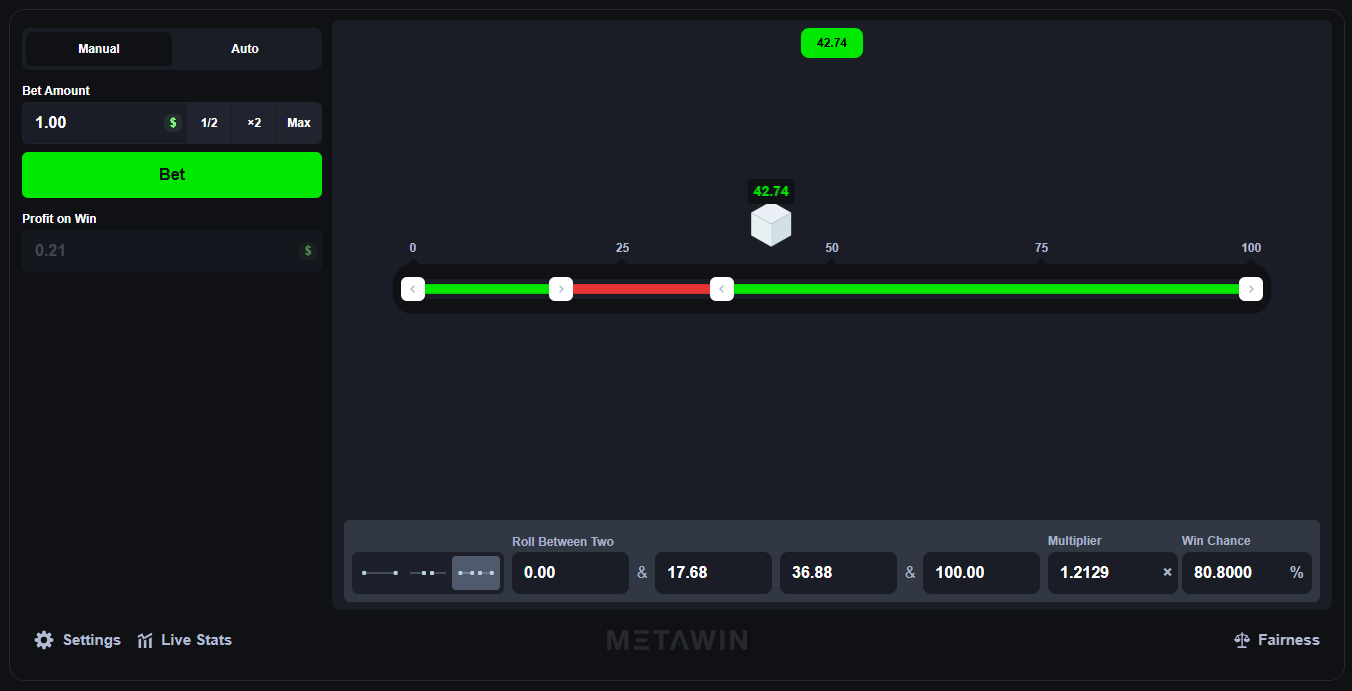
When you play crypto dice at MetaWin, each roll lands somewhere between 0.00 and 100.00. You choose a target, then decide whether you want the result to land above or below it. That choice sets how much of the range counts as a win.
For example, if you set the target at 50.00 and choose under, roughly half of all possible results work in your favour. That gives you a 50% dice win chance and a relatively low multiplier. Set the target at 10.00 and choose under, and only a small part of the range now pays. Your win chance drops, so the multiplier rises to reflect the extra risk.
The same logic works in reverse. A broader range gives you more ways to win, so each win pays less.
Think of the target as a line that splits the 0-100 range. Over or under decides which side of that line counts as a win. Your win chance depends on how large that side is, and the payout moves in the opposite direction.
What is the dice payout formula?
MetaWin uses the same formula to calculate the multiplier at every win chance.
Payout multiplier = (100 - house edge %) / win chance %
Since MetaWin Dice has a 3% house edge, you first subtract 3 from 100. That leaves 97, which you then divide by the win chance of your bet.
With a 50% win chance, the calculation looks like this:
(100 - 3) / 50 = 1.94x
A bet with a 50% chance of winning therefore pays 1.94x. With no house edge, the fair mathematical payout would be 2.00x. The slightly lower multiplier is where MetaWin's 3% edge appears.
Check it yourself: multiply the multiplier by the win chance and you get the game's RTP. In the MetaWin Dice screenshot at the top of this guide, 1.2 x 80.83% comes to 97%. It works on any dice game, so it's a quick way to see what edge you're playing against.
Here's how it looks in practice
Say you choose a 25% win chance and place a $10 bet.
| Bet detail | Figure |
|---|---|
| Win chance | 25% |
| Bet amount | $10 |
| Multiplier | 97 / 25 = 3.88x |
| Total returned | $38.80 |
| Profit | $28.80 |
The $38.80 return includes your original $10 stake, so the amount you actually win on top of it is $28.80.
You can use the same calculation for any dice payout. As the win chance drops, the multiplier increases to balance out the lower probability of a win. Try a few settings in the calculator below.
Dice payout calculator
Pick a game, set your win chance and stake, and see what the bet pays.

Author's Thoughts
Matija Antic
What I like about dice is that the whole deal fits on one line. Divide 97 by your win chance and you have the multiplier. There's no paytable to dig through.
Win-chance x payout table
You can see the relationship between dice odds and payouts pretty clearly in the table below. Every figure uses MetaWin Dice's 97% RTP and 3% house edge, next to what the same bet would pay with no edge at all.
| Win chance | Payout multiplier | Payout with no house edge |
|---|---|---|
| 50% | 1.94x | 2x |
| 25% | 3.88x | 4x |
| 10% | 9.7x | 10x |
| 5% | 19.4x | 20x |
| 2% | 48.5x | 50x |
You can think of the table as a sliding scale. At 50%, wins have a relatively large part of the roll range available to them, so the payout is 1.94x. At 10%, that winning range becomes much smaller and the multiplier rises to 9.7x. At 2%, it reaches 48.5x.
A lower win chance therefore gives you a larger potential return, but successful rolls become much less common. Raise the win chance and you get the opposite.
Either way, the house edge is fixed at 3%, so changing the setting does not improve the underlying odds in your favour.
RTP vs house edge: what's the difference?
RTP and house edge are directly linked. One shows the long-term return to players, and the other shows the casino's margin.
MetaWin Dice has a 97% RTP. In simple terms, that means the game is designed to return about $97 for every $100 wagered over a very large number of bets. The remaining $3 represents the crypto dice house edge, which is 3% at MetaWin.
That does not mean you lose exactly $3 every time you bet $100. A short session can finish well above or below that figure because individual rolls are random. RTP only becomes useful as a long-term average.
It also applies to everything you wager, rather than the amount you originally deposited. If you start with $100 and place ten $10 bets, you have wagered $100 in total. Keep using the same balance for more rolls, and that total keeps climbing.
So the two figures always connect. A 97% RTP leaves a 3% house edge, and that 3% is already built into every payout MetaWin Dice offers.
Not every dice game uses the same figures. Prime Dice, MetaWin's range-based dice game, runs at a 98% RTP with a 2% edge, so the same win chance pays slightly more there.
The house edge is separate from how MetaWin verifies each result. If you want to see how individual rolls can be checked after the fact, our provably fair guide walks through the process.
Author's Thoughts
Matija Antic
A 97% RTP is a long-run number. One session can finish well above it or well below it, and neither result tells you anything about the next roll.
Why does the house edge always apply?
Since MetaWin's 3% house edge is already built into every payout, changing your stake or the way you place your bets does not remove it. A $1 bet and a $100 bet face the same underlying edge, and the same applies whether you bet manually or follow a fixed pattern.
Different crypto dice betting strategies can change how quickly your balance moves or how much you risk after each result, but they do not change the odds of the next roll.
No betting system can remove the house edge or guarantee a profit, so set a budget before you play and treat it as money you can afford to lose.


