


Provably fair is one of those iGaming phrases most of us have heard countless times without ever stopping to understand what it actually means. Dig any deeper into what it covers, how it works or what players get from it, though, and clear answers become much harder to find.
In short, it means the game locks in the outcome of your bet before you place it, and you can prove that afterwards using a cryptographic hash. That commitment is what separates a provably fair casino from a casino that simply asks you to trust it.
Every MetaWin Original runs on this system. You don't need to file a support ticket to use it either, because once the relevant seed pair has been retired, you can pull up any round you played with it and check the result from your own account.
What is provably fair gaming?
Checking a result yourself only makes sense once you know the ingredients behind it.
Every round comes down to three moving parts. The server seed belongs to the casino, the client seed belongs to you, and the nonce is a counter that ticks up by one with every bet you place on that pair.
The server seed is the first one you see evidence of. Before you wager anything, a provably fair casino shows you its hash, locking the house into one value before it sees your bet. Any attempt to swap that value afterwards would show when the original seed is revealed.
A hash is a one-way fingerprint of whatever goes into it. Change a single character of the server seed and the result looks nothing like the hash you were shown, so a swapped seed gives itself away.
Therefore, provably fair gambling is better understood as a verification system than as one universal algorithm. It combines cryptographic hashes, server and client seeds, and nonces to let players confirm that completed results were not altered.
How does MetaWin's provably fair system work?
Our platform generates the server seed, and you only ever see it as a SHA-256 hash until the pair is retired. SHA-256 is the particular hash function we use, and it is also used by the Bitcoin network. Another provably fair Bitcoin casino may rely on the same building blocks without arranging them in exactly the same way.
Your client seed arrives pre-generated too, but this is the one you control, and you can swap it for a value of your own whenever you like.
The nonce is the simplest of the three because it just keeps count. It starts at zero with a fresh seed pair and rises by one with every bet.
The server seed, client seed, and nonce then pass through the game's calculation to produce the outcome, whether that is the number a Dice roll lands on or the multiplier where a round of MetaWin Crash reusing the seeds does not produce the same result because the nonce changes with each wager. stops climbing.
By the time your bet lands, we are committed to a server seed we cannot change, while the client seed gives you control over one of the other inputs. Every provably fair crypto casino runs some version of this, though the field names and where they live differ from one site to the next.
Once the server seed is retired and revealed, you can use the same inputs to reproduce the calculation and check the result.
How do you verify a MetaWin game result?
That check happens in the Fairness panel, which opens from inside any Original or from your account menu. The first run takes a few minutes while you find each value. After that, you only need to copy the three values and compare the result the panel returns.
1. Open the Fairness panel
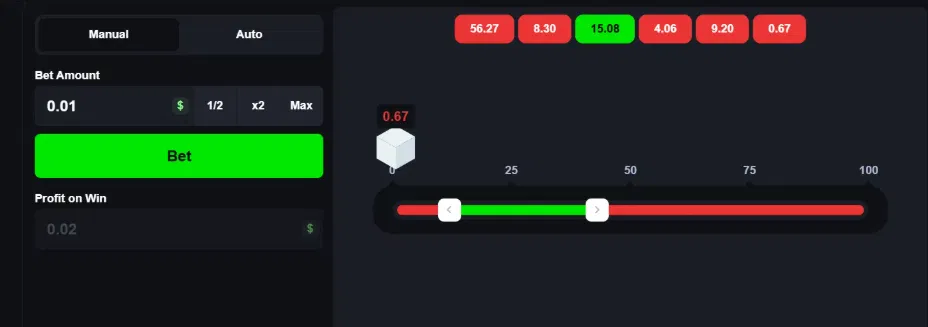
Load an Original and open Fairness from the game menu, or reach the panel from your account menu. We ran this one on the Prime Dice: Original game, and the Seeds tab lists your Active Client Seed, the hashed Active Server Seed and your current Nonce.
2. Copy the hashed server seed before you bet
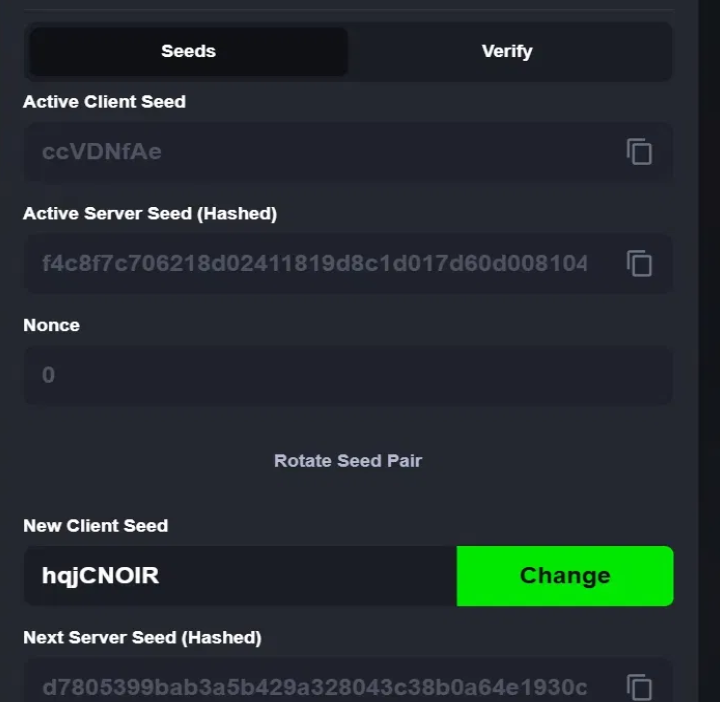
The Seeds tab is the only place that value exists, and since rotating replaces it, make sure you copy it now and keep it somewhere you can find it. Everything you do later compares back to this string.

3. Rotate the pair and find the revealed seed
Rotating retires the pair you have been playing on and moves you onto the next one, and the server seed you were using appears in full. Run that seed through any SHA-256 tool and the output should match the hash you copied a moment ago, character for character.
4. Enter the round details in the Verify tab
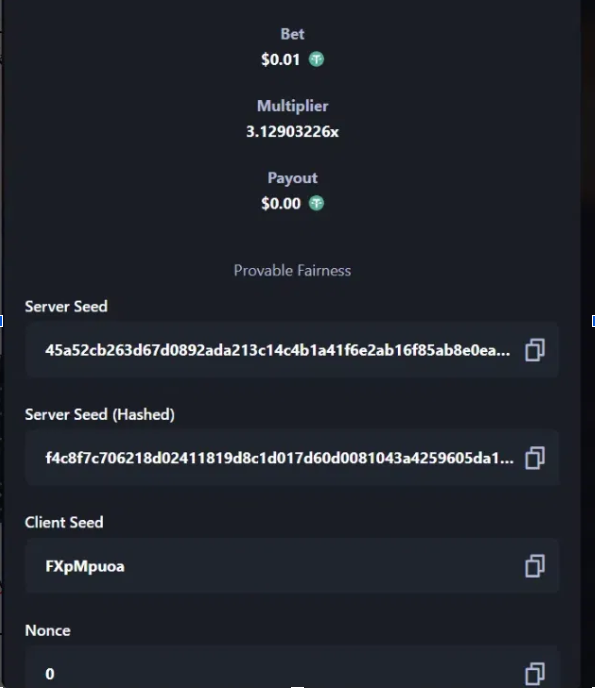
Switch across to Verify, pick the title from the Game dropdown, then open the round in My Bets to read off its client seed and nonce and paste those in alongside the revealed server seed.
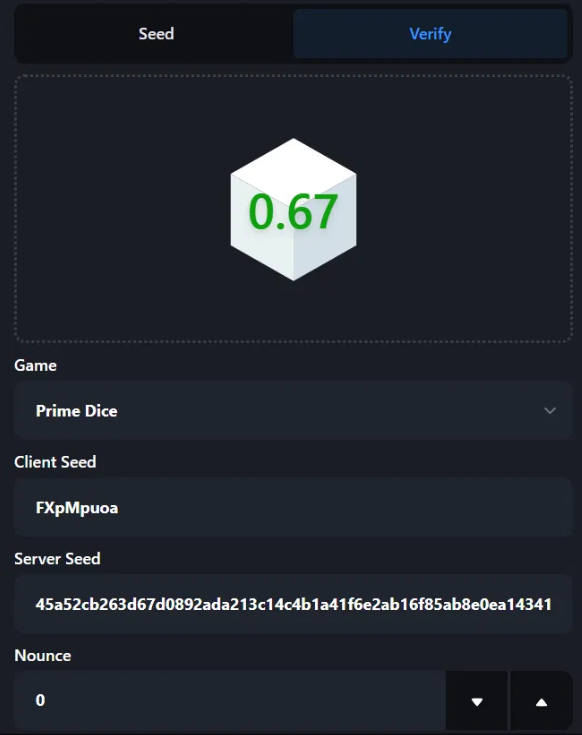
5. Compare what comes back
The panel works as a provably fair calculator, rebuilding the outcome from those three inputs and nothing else. Ours matched the roll we had played, showing that the outcome came from those inputs and was not altered afterwards.
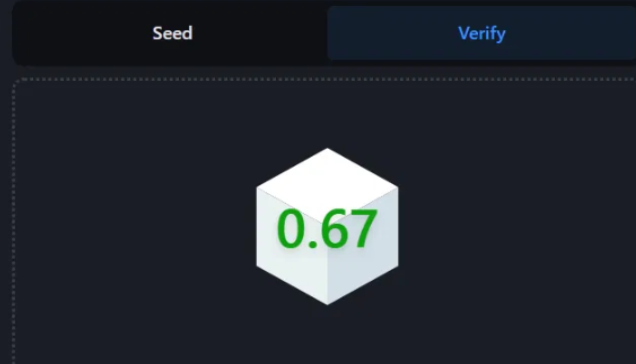
All of this works backwards by design, since provably fair verification depends on a server seed that stays hidden while the pair is in play. You check rounds once you have rotated away from the pair you played them on, so a session confirms itself after the fact.

Author's Thoughts
Matija Antic
The step people skip is copying the hashed server seed before they play. Without it, you've got nothing to compare the revealed seed against, so grab it first.
How do you change your seeds?
You rotated once already to run that check, and you probably saw that the Seeds tab holds two controls with different purposes.
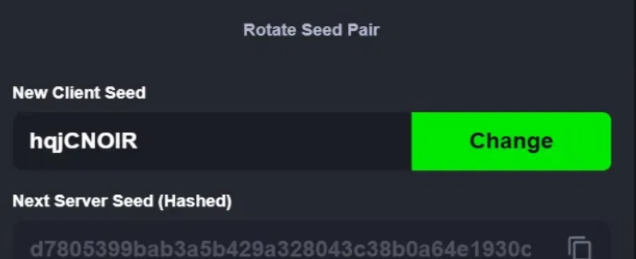
To change the seeds, start with New Client Seed, which takes any value you type. The Change button swaps it in without touching the active server seed, so the hash you were shown stays as it was.
Rotate Seed Pair is the bigger move, since it retires the server seed you played on, reveals it, and moves you onto the pair whose hash already appears under Next Server Seed (Hashed). That hash is the commitment for rounds you have not played yet.
Before you touch it, make sure to use the copy icons, because rotating clears those values off the screen and you will want to be able to access them later. With those saved, rotating at a natural break turns everything on that pair into checkable rounds at once, instead of piling up out of reach.
Which MetaWin games are provably fair?
A verification panel is only worth as much as the games it reaches, and ours reaches everything MetaWin Studios builds in-house.
Most of the provably fair casino games here are instant games, built around quick rounds and your own decisions. Prime Dice and Dice cover the provably fair dice side, MetaWin Crash asks only when to cash out, MetaWin Mines adds tile choices before that same question, and Plinko, Limbo, Dragon Tower and the rest each trade risk against payout their own way.
Table games are the ones people do not expect to be checkable, since cards and a wheel feel like they need their own machinery.
However, MetaWin Blackjack, MetaWin Roulette, Roulette Pro, MetaWin Baccarat, and MetaWin Keno generate results from the same three types of input as a dice roll and can be reproduced in the same way, so a provably fair blackjack hand or a provably fair roulette spin holds up to the same scrutiny.
Anything we have not named here is in the full MetaWin Originals lineup., where RTPs run from 96% on Pepe's River Run to 99.5% on Blackjack and Baccarat.
We cannot say the same for the slots, since they come from external studios and run on those providers' own certified RNGs. Those get tested independently, just not by you and not through this panel.
How is provably fair different from standard RNG?
For those of you unfamiliar with the term, a certified RNG is the random number generator behind a game, tested and signed off by an independent lab. Slots, roulette spins and card shuffles all rely on one to produce results designed to be unpredictable.
Once a lab has tested and signed off the generator, that certificate is all you get. Retesting comes later, which leaves you reading someone else's verdict, while a provably fair system puts the check in your hands and takes seconds.
The difference becomes clearer when you look at what each one covers. Certificates speak for the game as a whole, across millions of rounds and none of them yours in particular, whereas the seeds speak for exactly one round, the one that bothered you.
Neither cancels the other, and no provably fair algorithm removes the need for a licence or a lab, which is why we carry both.
Author's Thoughts
Matija Antic
Provably fair and certified RNG answer different questions. A lab certificate vouches for a game across millions of rounds, while a seed check proves that one specific round of yours wasn't touched.
What provably fair does not guarantee
Verification only tells you whether a result came from the committed server seed, client seed, and nonce recorded for that round, then remained unchanged afterwards. It does not remove the house edge or improve your odds. A verified losing round is still a losing round.
This panel does not verify third-party slots, and the system does not replace licensing, independent testing or the rules of the game itself.
Being able to audit a round should give you evidence, not a reason to wager more. If play stops feeling like entertainment, our responsible gambling guidance explains the tools available to help you step back.
Did You Know?
Provably fair gambling is older than most crypto casinos. SatoshiDice launched in 2012 and settled every bet directly on the Bitcoin blockchain, meaning anyone in the world could audit its results. The idea that a player should be able to check the house rather than take its word for it dates from there.
SHA-256, the hash function behind the seed commitment, is the same one that secures the Bitcoin network. It turns any input into a fixed 64-character output, and changing a single character of the input changes almost the entire result. That is exactly why a hashed server seed works as a promise: swap the seed and the hash no longer matches.


