



Dice is usually one of the first games people try at a crypto casino, and ten seconds with it shows you why. You set a target, call whether the roll will land above or below it, and that's the whole game. No paylines, no bonus rounds, no strategy chart to memorise.
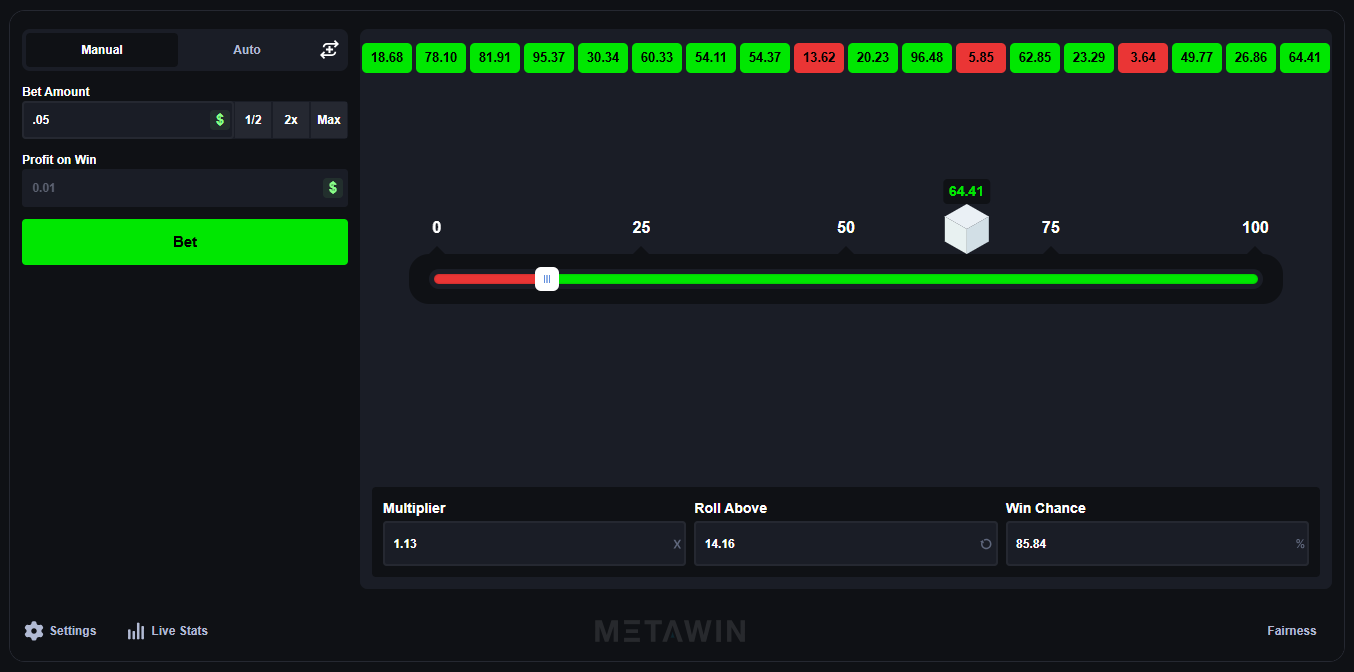
Learning how to play crypto dice really comes down to understanding the numbers on screen. Your target sets the boundary for the roll, while your win chance and payout show the trade-off you are making.
So we'll start there, then walk through a first roll one step at a time. By the end of this piece, you'll be able to set one up yourself and know exactly what you're risking before you click bet.
What is crypto dice?
The name is a bit of a misdirection, because there's no physical die anywhere in this game. Nothing has six sides. What you actually get is a number between 0.00 and 100.00, generated fresh for every bet, and your job is to guess which side of a target it lands on. The crypto part simply means you fund and place the bet using cryptocurrency.
You set that target yourself. Say you put it at 50.00 and call under. Now every roll from 0.00 to 49.99 pays you, and everything from 50.00 upwards loses. Call over instead and you back the other side of the target.
That's the over/under dice model, and the basic idea stays the same wherever you play it. One number, one target, one call.
The interesting part is that you're not stuck at 50.00. Drag the target down to 10.00 and calling under leaves you a narrow range to land in, so you'll lose far more often than you win. Push it up to 90.00 and most of the range works in your favour.
The payout moves in the opposite direction. Wins that come easily are worth less, and wins that come rarely are worth more. Neither setting removes the house edge, so one is not mathematically smarter than the other.
So the crypto dice rules come down to two decisions. Where do you put the target, and which side of it do you back? Everything else on screen shows you the trade-off those choices create.
How do you play crypto dice, step by step?
There are three steps between opening a dice game and your first roll, and none of them takes more than a few seconds once you know your way around.
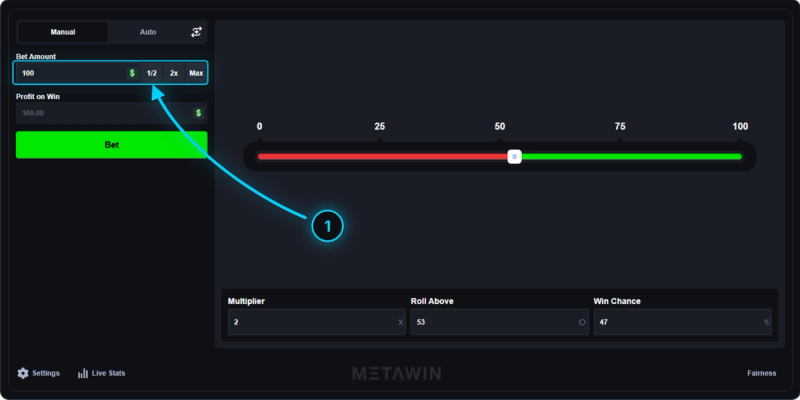
Step 1: Set your bet and target number
Enter a stake in the Bet Amount field and use the 1/2 and 2x buttons to adjust it quickly. Then drag the slider or type a value into the target field. This is the line that splits the range: a target of 25.00 puts the boundary near the bottom, while 75.00 puts it near the top. The win chance and multiplier update the moment you move it.
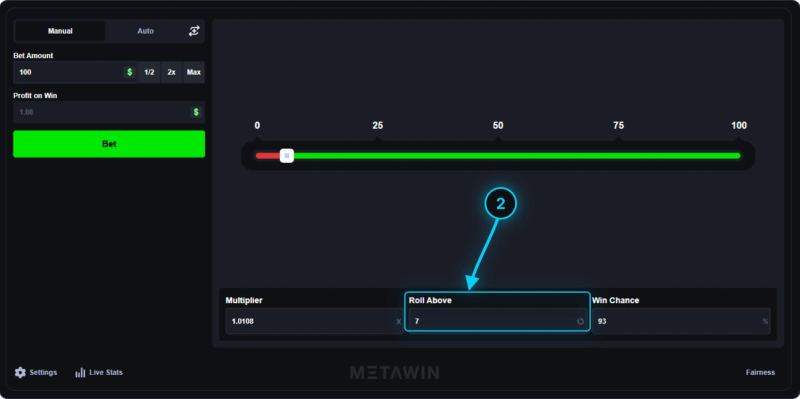
Step 2: Choose over or under
Pick which side of that target you're backing, using the toggle next to the Roll Above field. Over means you need a roll higher than your number, while under means lower. The win chance swaps to whatever was left over when you flip it.
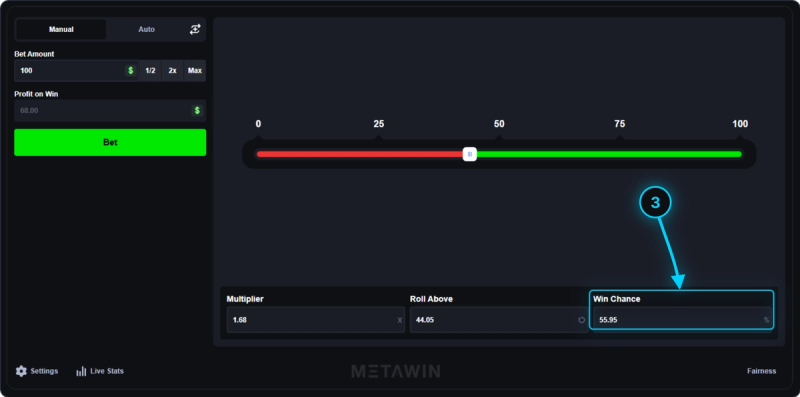
Step 3: Check your win chance and payout, then roll
Read the win chance and multiplier before you commit - those two numbers are the actual terms of the bet. Below that, Profit on Win shows what a winning roll adds to your balance, not the total returned. When you're happy with both, hit Bet and the result lands straight away.
How do target, over/under and win chance work?
Those two numbers you checked before hitting Bet are two sides of the same relationship. Win chance tells you how often you'd expect to win, and the multiplier prices that frequency.
Back at our earlier target of 50.00, with under called, you win on anything from 0.00 to 49.99. That's half the range, so the game shows a 50% win chance and a multiplier of 1.94x, meaning a stake of 1 comes back as 1.94 in total, original stake included.
What if you'd rather chase something bigger? Pulling the target down to 25.00 shrinks your winning range to a quarter of the board, so the win chance drops to 25% and the multiplier climbs to 3.88x. You've halved your win chance and roughly doubled what a win pays.
The reverse holds just as neatly, because a target of 90.00 leaves you winning on almost anything, which reads as a 90% win chance. The multiplier falls to 1.08x to match, so wins come more often while a stake of 1 returns 1.08.
None of this is guesswork on the casino's part. You subtract the 3% house edge from 100, then divide what's left by your win chance, which at 50% means 97 divided by 50 and a multiplier of 1.94. That sum holds anywhere on the slider and, once rounded, matches what the panel shows.
And that's the bit worth pausing on. MetaWin Dice runs at 97% RTP, with that 3% folded into every multiplier at every target you can set. Wherever the slider ends up, your wins change shape, smaller and more frequent or bigger and rarer, but the edge underneath never moves.

Author's Thoughts
Matija Antic
The 97 divided by your win chance formula is the most useful thing to learn in dice. Once it clicks, every multiplier on the slider makes sense, and you'll never mistake a bigger payout for a better bet.
Auto-bet and beginner tips
There's no need to rush into a roll, as a couple of settings are worth checking first.
Auto-bet repeats the same setup for a chosen number of rolls, but its useful part isn't really the speed. It's the stop conditions. You decide in advance how much you're willing to lose before auto-bet shuts off, so that call gets made while you're calm rather than halfway through a session.
Much the same thinking applies when you play manually. Set a session budget before opening the game and treat it as the maximum you can lose, however the rolls go.
As you learn how to play bitcoin dice, you'll find higher win chances are gentler to start on. Winning rolls come more often, which makes the panel easier to follow, while the smaller multiplier shows you the other side of that trade-off.
Stop-losses and win-chance settings control how you play, not whether you come out ahead. No betting system removes the house edge or turns dice into a profitable game, and our crypto dice betting strategies guide covers how the well-known ones actually work.
Author's Thoughts
Matija Antic
Set your stop-loss before the first roll, not after a bad run. It's the one decision in dice you want to make with a clear head.
How do you know a roll is fair?
Speaking of things you can check for yourself, every Dice roll at MetaWin is provably fair. Before you bet, the game shows you a hash of its hidden server seed. Think of it as a fingerprint that conceals the seed but locks MetaWin into that exact value.
Your client seed and a counter called the nonce go into the calculation alongside it, and together they produce the roll. Once the original server seed is revealed, our provably fair explained guide shows you how to use those same inputs to rebuild the result and confirm that nothing changed afterwards.


