



The history of crash games is short by any measure, with just a little over a decade between a forum experiment and a fixture of nearly every crypto casino. Today, any player can browse any casino out there and almost certainly stumble upon at least one crash game.
That story began in 2014 with MoneyPot, a Bitcoin game that ran entirely on crypto long before mainstream operators paid attention.
In this article, we'll follow how BustaBit set the template, how provably fair crash games gave players a reason to trust the process, how Aviator carried the format into the mainstream, and why crash games and crypto grew up together.
What exactly is a crash game?
Most casino games hand you reels to spin or cards to read, but a crash game throws all of that out. What's left is a single multiplier that starts at 1.00x and climbs higher the longer a round runs. It can crash without warning, so players have to cash out before it does. Leave it too late, and the stake is gone. That tug between greed and timing is really all there is to it, and it feels like a self-control exercise.
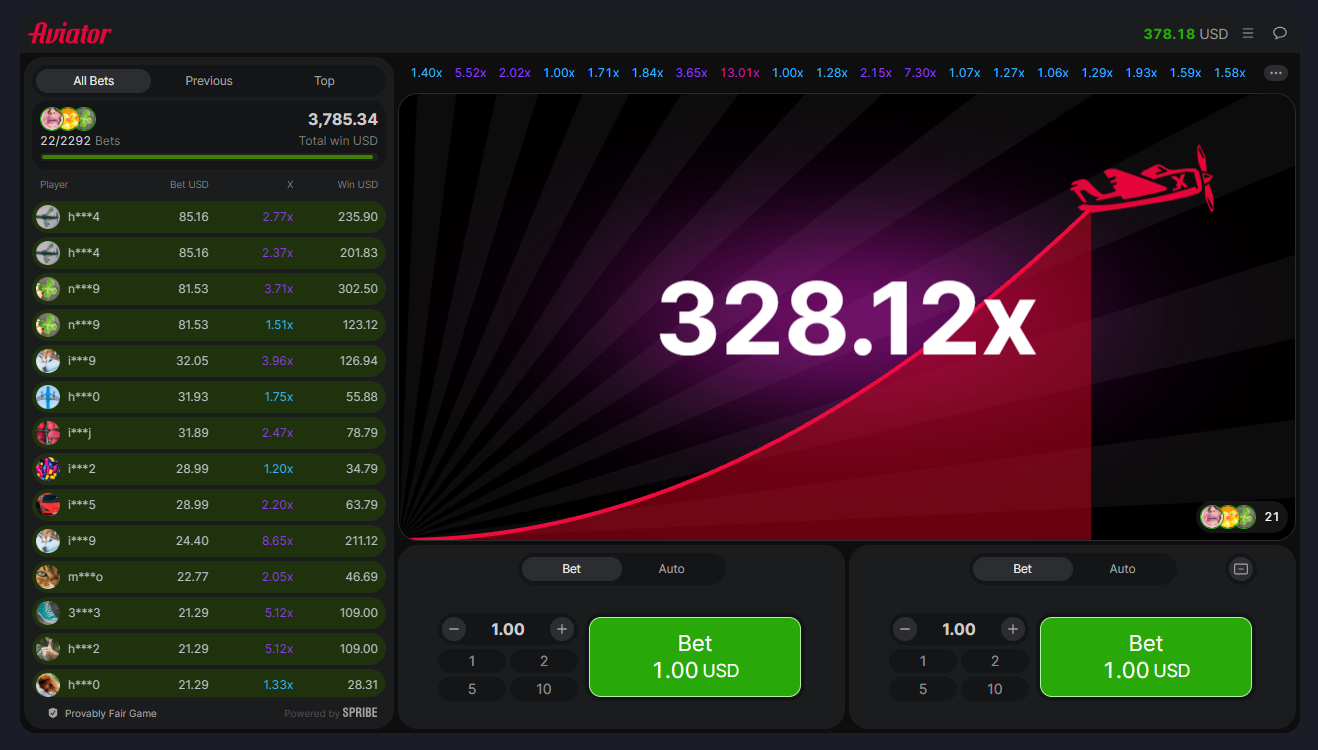
Structurally, they all share the same DNA, which is why Aviator can fly a plane and JetX a jet while the same maths drives each one. Ultimately, every crash game runs on a rising multiplier and a provably fair result that players can check for themselves.
Where did crash games come from?
To track the crash game origins, we go back to that already mentioned 2014 and the arrival of MoneyPot. In July of that year, a developer known as Eric Springer, or "espringer," introduced his new Bitcoin game to the Bitcointalk forum.
It ran entirely in BTC, which made it crypto-native from the very first round, back when the idea of a casino built around cryptocurrency was still fringe. And players took to it fast. Hundreds of BTC moved through the interface, and by September, the game was logging around 250,000 plays.
Springer's real breakthrough was not the rising multiplier on its own, though. He paired it with a provably fair system built on public seeding, so that players could be sure that a result had not been rigged.
All of that is what makes the game the genuine starting point of the genre, and the reason crash games and crypto have been tied ever since. The label "crash gambling" took a while to catch on, and only really stuck around from 2016 to 2017.
How did BustaBit set the template?
MoneyPot did not keep its name for long. In 2015, it was sold and relaunched as BustaBit, which is still running today and gets called the grandfather of the genre for good reason. It took the rough idea and polished it into something other operators could copy. The core mechanic is so tied to that one game that people still describe it as "bustabit mechanics."
Standardization of some core ideas includes:
- A single rising curve
- Instant Bitcoin settlement
- An open, provably fair seed chain
- A bet history anyone could read back
Combined, those turned a forum experiment into a repeatable template, the bridge between one developer's project and a format the whole industry could build on. By the close of the 2010s, provably fair had become the baseline any serious crash game was expected to meet, a standard inherited straight from MoneyPot and BustaBit.
Why did provably fair matter so much?
It is worth slowing down on why that standard carried so much weight. Provably fair addresses basic human nature, because it lets players trust a game they had no other reason to. And the mechanism is not complicated once you break it down.
Each round mixes a server seed, a client seed, and a nonce, all run through SHA-256. The casino publishes the hashed server seed before the round starts, then reveals the original once it ends, so anyone can re-run the numbers and confirm nothing was changed partway through. That mattered because crash games came about in a largely unregulated corner of crypto, where there was no licence to vouch for fair play. Cryptographic proof did that job instead.
It also explains why the category suits MetaWin so well, since verifiable fairness is native to crypto rails rather than bolted on after the fact. Every crash title at MetaWin carries that same guarantee.
How did Aviator take crash games mainstream?
Provably fair earned the genre's trust, but trust on its own does not make something a phenomenon. That part came later, and it came down to one title. Spribe, a studio founded in 2018 in Kyiv, released Aviator in 2019. It was not the first crash game, yet it became the one that put the concept on the map, and has probably been the most popular name in the genre ever since.
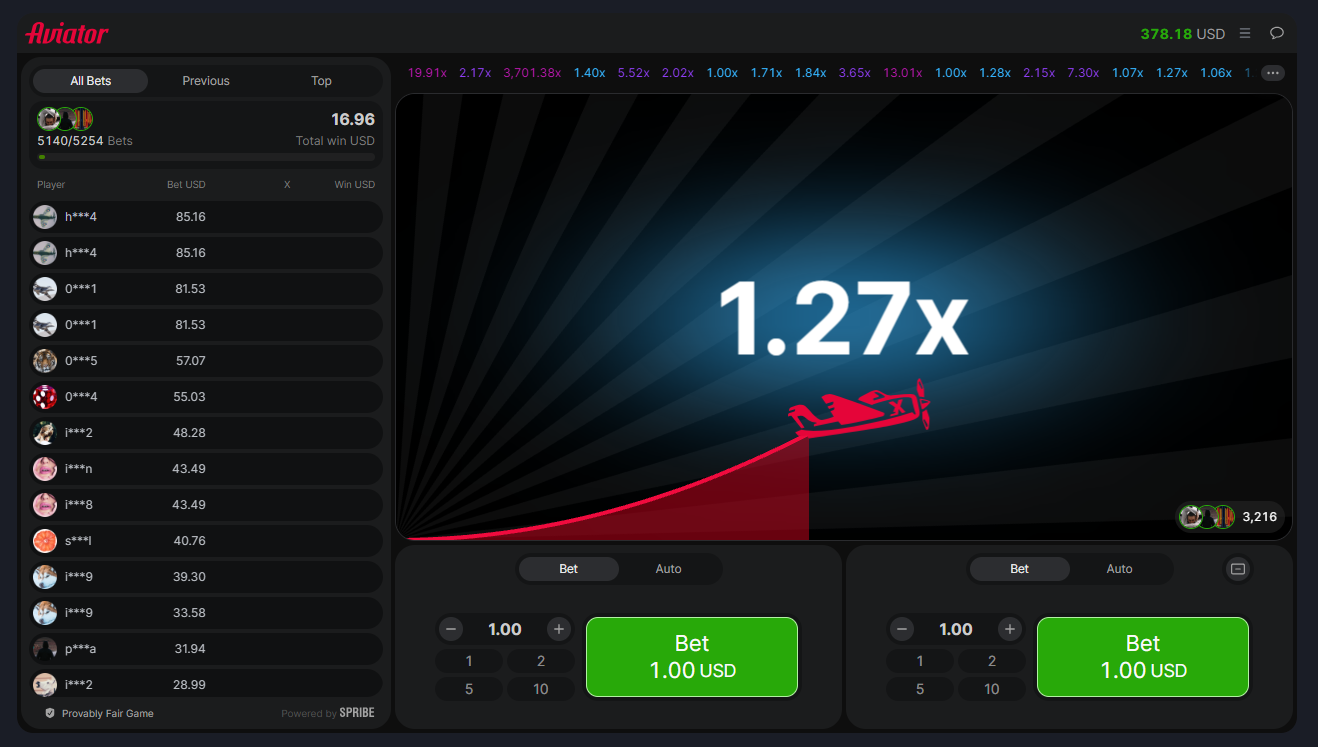
But Aviator did not tear up the BustaBit template, it built on it. The bare rising graph became a little plane climbing the screen, and around it, Spribe added a genuine social layer. Players could watch a live feed of other people's bets and cash-outs, chat mid-round, run two bets at once, and set an auto cash-out. A solitary numbers game turned into something closer to a shared event you could watch unfold.
While Aviator launched in 2019, the real explosion came around 2021, driven by huge uptake in India, Africa, and Latin America. By the way, JetX, from SmartSoft in 2018, followed a similar path. And there it was: a single game's reach has finally pulled crash games out of their crypto-native niche and into the mainstream lobby.
What came after Aviator?
Once Aviator showed what this game type could do at scale, the rest of the industry understood the assignment and moved quickly. By 2020, almost every crypto casino ran its own crash title, and they arrived as part of the wider arcade wave of Plinko, Mines, and Dice taking over lobbies at the same time.
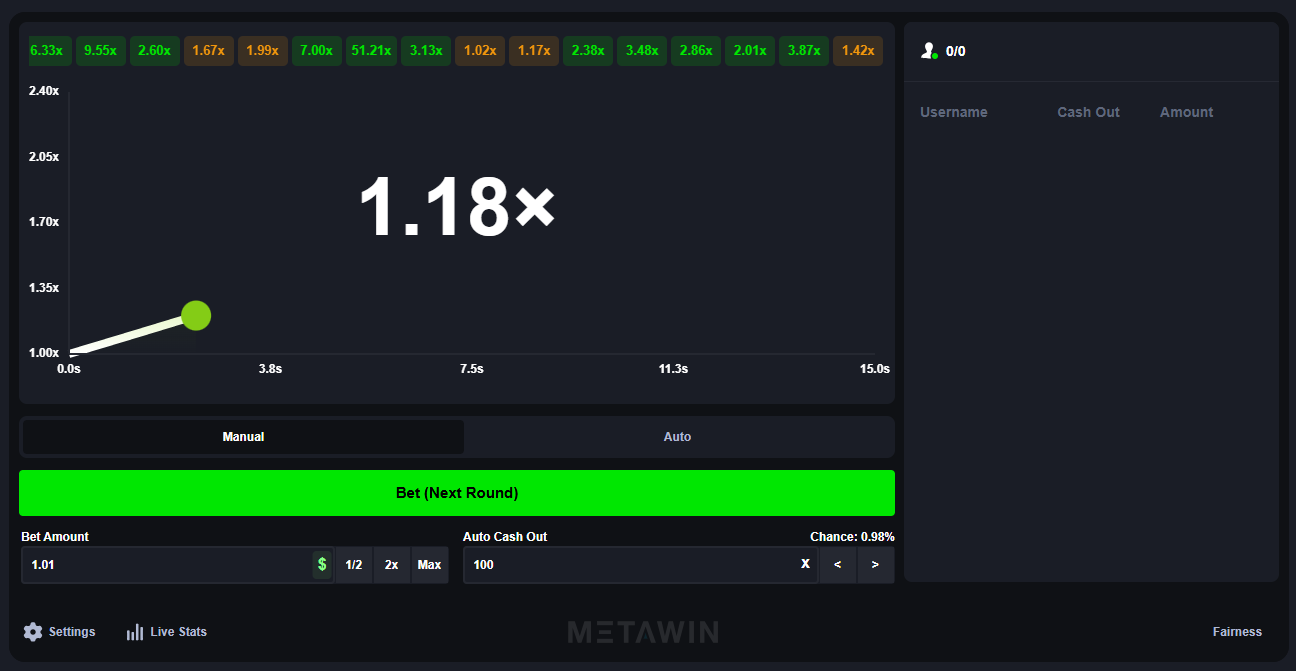
The format branched out. Some studios reskinned it around rockets, jets, and divers, others split it into multiplayer and solo versions, and a few kept their best titles in-house, playable in one place and nowhere else.
For all the new variety, the maths stayed put. The rising multiplier and the cash-out call work today the way BustaBit ran them years ago. The evolution was cosmetic and social, really, down to the presentation, the live features, and the buy-in and auto-bet controls every player now expects.
MetaWin Crash is the brand's own read on the genre, and it anchors a full line-up of crash titles worth a look. By this point, the crash had stopped being a trend and settled in as a permanent category in the crypto casino lobby.
Why are crash games and crypto casinos so closely linked?
Here are three main things that connect the history of crash games with an online crypto casino like MetaWin.
- Origin: Crash started life in Bitcoin, on a forum, and played in BTC from the very first round. It was never a fiat casino product later reworked for crypto, which is rare for any format and tells us a lot about where it belongs.
- Verifiability: Provably fair was the genre's foundation, and that maps cleanly onto wallet-based, on-chain play. The proof a player wants is the same proof a blockchain is built to give.
- Tempo: A crash round is over in seconds, and that pace fits instant crypto deposits and withdrawals far better than the slow back-and-forth of traditional banking rails.
Crypto-first brands fill their lobbies with crash titles for that exact reason, while conventional casinos barely touch the genre. A traditional operator can graft the format on, but the things that make it click, the speed, the verifiable result, the wallet-native flow, are exactly what a fiat setup struggles to deliver.
None of that effort is needed at a crypto-native casino like MetaWin, where crash already fits the rails it runs on instead of arriving as a borrowed idea. For anyone who wants to try the titles themselves, MetaWin's crash games gather the current line-up in one place.
Where are crash games headed?
Calling the future is guesswork, but a few directions look plausible. The social layer that Aviator opened up should keep deepening, pushing crash further toward something you stream and watch.
On-chain provably fair may shift from a technical footnote to a headline brands sell on. And the mechanic itself keeps spreading, turning up inside slots and other formats. Through all of it, the two traits that defined crash from 2014, a rising multiplier and a verifiable result, seem unlikely to change.
Did you know
Aviator wasn't the first crash game - MoneyPot beat it by five years. But Aviator's live bet feed and in-round chat turned a solo maths game into a shared spectacle, which is what finally pushed the format mainstream around 2021.

