


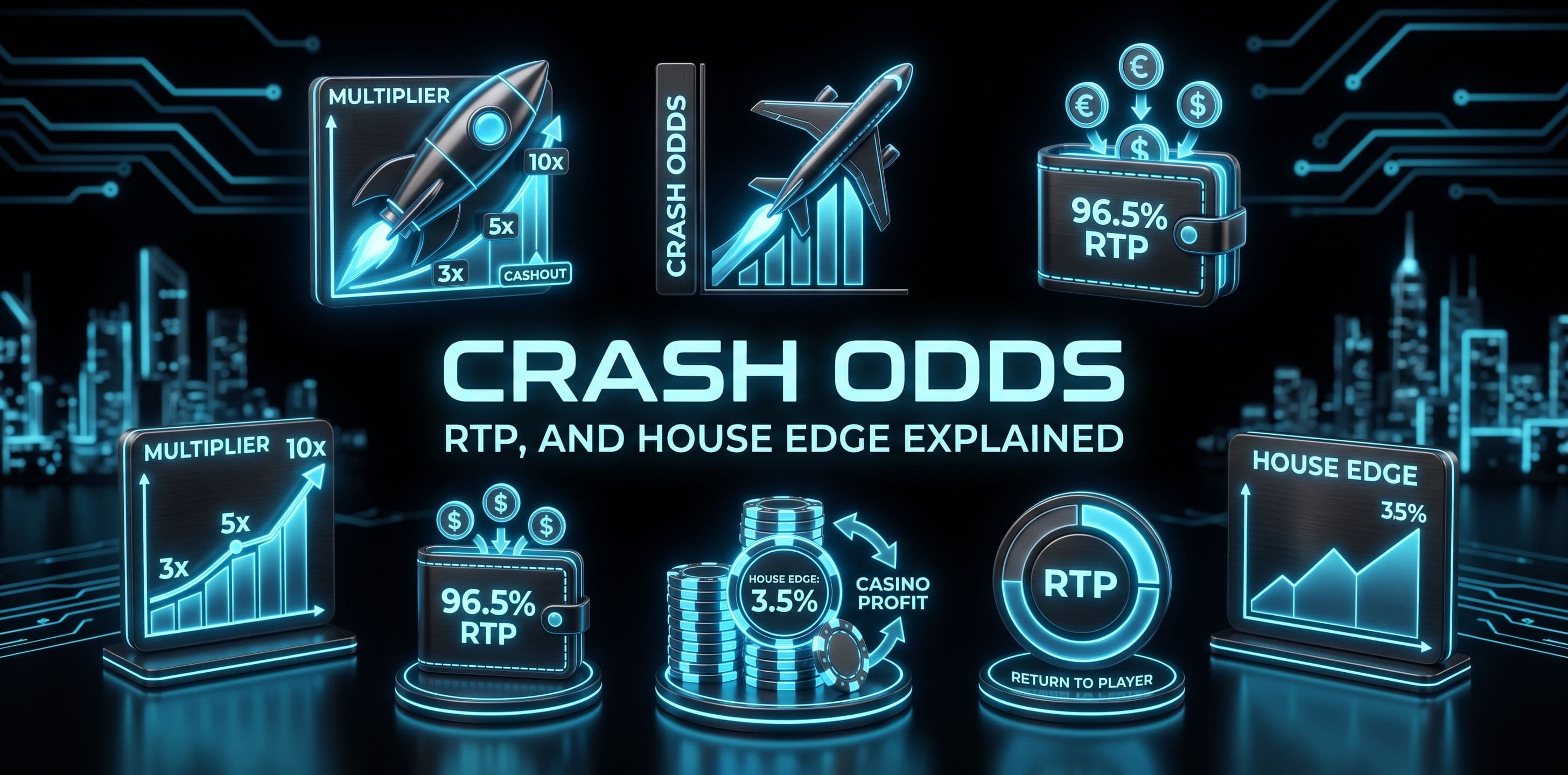
In this guide, we'll give you the tools to understand crash odds, what the house edge means for long-term returns, and the chance of reaching any multiplier. A rising multiplier leads to a simple crash gameplay loop, but the odds can look complicated at first glance. The good news is that the math under these games is relatively straightforward once you unlock the concept of reach probability.
It gives you a way to know the approximate chance that any round reaches a particular multiplier before crashing. The RTP (return to player) is part of what sets the probability, while the house edge points to the advantage the casino has over the long term. By the end of this guide, you'll see how these numbers link together and also know how to calculate the crash reach probability for multiplier targets.
How Do Crash Odds Work?
Crash odds are built around a simple trade-off where the higher the multiplier you target, the less likely the round is to reach it. A crash game might rise through 1.2x, 1.5x, and 2x before eventually ending, or it could continue to 5x, 10x, or much higher. You never know in advance where the crash will happen.
This is why your decision is important. If you wager $10 and cash out at 2x before the multiplier crashes, you get $20 in return plus your original stake. Going for a bigger 10x multiplier would return a bigger $100 in profit, but the chance of reaching it is much lower. If the game crashes at 7x, you would already secure your payout if you cash out at 2x, but you will lose your bet if you are waiting to cash out at 10x.
You get the same concept whether you cash out manually or use the crash auto cashout feature, which allows you to automate rounds to cash out on a specific multiplier target. A lower target usually means you'll cash out successfully more often but get smaller payouts. Targeting higher multipliers means you'll lose more rounds, but the potential payout is bigger.
One important point about all crash games is that the result of the previous round does not change the odds of the next one. A series of low multipliers does not make a high multiplier "due". Crash outcomes are independent, so choosing a target is about managing the balance between potential payout and the likelihood of reaching it.

Author's Thoughts
Jeffrey Gynn
A series of low multipliers does not make a high multiplier "due". Crash outcomes are independent, so choosing a target is about managing the balance between potential payout and the likelihood of reaching it.
What is the Crash Reach-Probability Formula?
The reach probability in crash has the formula of the game's RTP divided by the target multiplier (Reach Probability = RTP / target multiplier). What you get from this formula is an estimate of the chance of a round reaching a multiplier before ending.
If you play crash games at MetaWin with a 98% RTP and a target multiplier of 2x, the reach probability is 98 / 2 = 49%. In other words, there is a 49% chance of a round reaching the 2x multiplier, which means around half of all rounds will get to this target.
You can take the same calculation and plug it into any multiplier target. This explains the fundamental relationship between crash multipliers and probability. Doubling the target multiplier roughly halves the estimated chance of reaching it.
Nothing here is a guarantee of any outcome for an individual round, but it instead shows theoretical outcomes over the long term. Crash game mechanics and multiplier distributions can change between games.
| Target multiplier | Approx. reach probability |
|---|---|
| 2x | 49% |
| 5x | 19.6% |
| 10x | 9.8% |
| 100x | 0.98% |
Crash reach probability curve (98% RTP)
Approximate chance of reaching each multiplier target
Crash reach probability calculator
Enter the RTP and your target multiplier to see the approximate chance of reaching it.
This table shows the trade-off that is a part of every crash game, where you must choose between risk and reward each round. It shows that a 2x target is likely to happen around 49% of the time, but the probability starts dropping by clear margins for higher multipliers.
The reason this happens is simple, it's because the potential payout increases alongside the multiplier, but the probability of crashing also increases. A multiplier of 10x would return a bigger payout but has a much lower chance of happening, so more losing rounds occur.
This is where the risk and reward cycle of crash games comes from. Lower targets favor frequency over payout size, while higher targets favor payout size over frequency. Neither option changes the underlying crash house edge.
RTP vs House Edge in Crash
The RTP (return to player) and house edge describe the same mathematical advantage from opposite sides of the equation. Crash RTP is the theoretical percentage of wagers returned to players over a very large number of bets, while the house edge is the percentage the casino theoretically keeps.
You can look at it like whatever is left over from RTP is the house edge, so a 98% RTP means a 2% house edge. It's also possible to reverse this concept, so if a game has a house edge of 3%, you take what's left over as the RTP, which is 97%.
Our own MetaWin Crash, as well as Speed Crash, have RTPs of 98%, so a 2% house edge. Aviator's and Top Eagle's RTP are 97%, so these popular crash games have a 3% house edge. Navigator by MetaWin Studios matches this RTP and house edge at 97% and 3%, respectively. If you're wondering "are crash games fair?", all of our titles have either provably fair verification or results decided on certified RNGs (random number generators).
Author's Thoughts
Jeffrey Gynn
MetaWin Crash and Speed Crash have RTPs of 98%, giving them a 2% house edge. Aviator and Navigator both sit at 97%. If you want the lowest house edge available, those 98% games are the ones to look at.
Why the House Edge Always Applies
The house edge is built into the mathematical connection between the multiplier and the crash reach probability. Every crash game has a theoretical RTP, so the casino always has a small mathematical advantage over a large sample. Even so, the decisions you make can change the variance you see over individual sessions, even if they cannot remove the overall edge.


