



USDT overtook Bitcoin as the most-deposited coin on the largest crypto sportsbooks in 2023, and the stablecoin's lead has grown wider with every season since.
On paper, the change makes little sense because Bitcoin built this industry. The first crypto books ran on it, priced their limits in it, and paid every winner in it.
Then you have Tether, a stablecoin that pays no interest and never rallies. And still, the most serious bettors in the game now fund their accounts with it by default.
Here, we'll take a closer look at why they're increasingly choosing USDT over Bitcoin.
We'll start with the volatility problem because a Bitcoin bankroll turns every wager into a side bet on BTC itself. From there, we'll cover how a dollar peg removes that noise, what separates USDT from USDC and DAI, which chain to use for each, the one scenario where a volatile coin still earns its place, and the steps to bet with stablecoins at MetaWin.
We built MetaWin Sports for this kind of flexibility, with stablecoin deposits on multiple chains and a cashier that holds USDT alongside BTC, ETH, SOL, LTC and 25+ other coins. The post is part of our series on the right coin for the right job, and our guide to the best crypto for sports betting compares the full lineup.
We wrote this one for the bettor who tracks a bankroll, sizes stakes with discipline, and grinds a thin edge over hundreds of bets. If you bet casually and want one quick answer, the broader guide to crypto gambling will serve you better.
The volatility problem (and why it matters more than you think)
If you've ever won a bet and watched your balance shrink anyway, this section puts exact numbers on what happened.
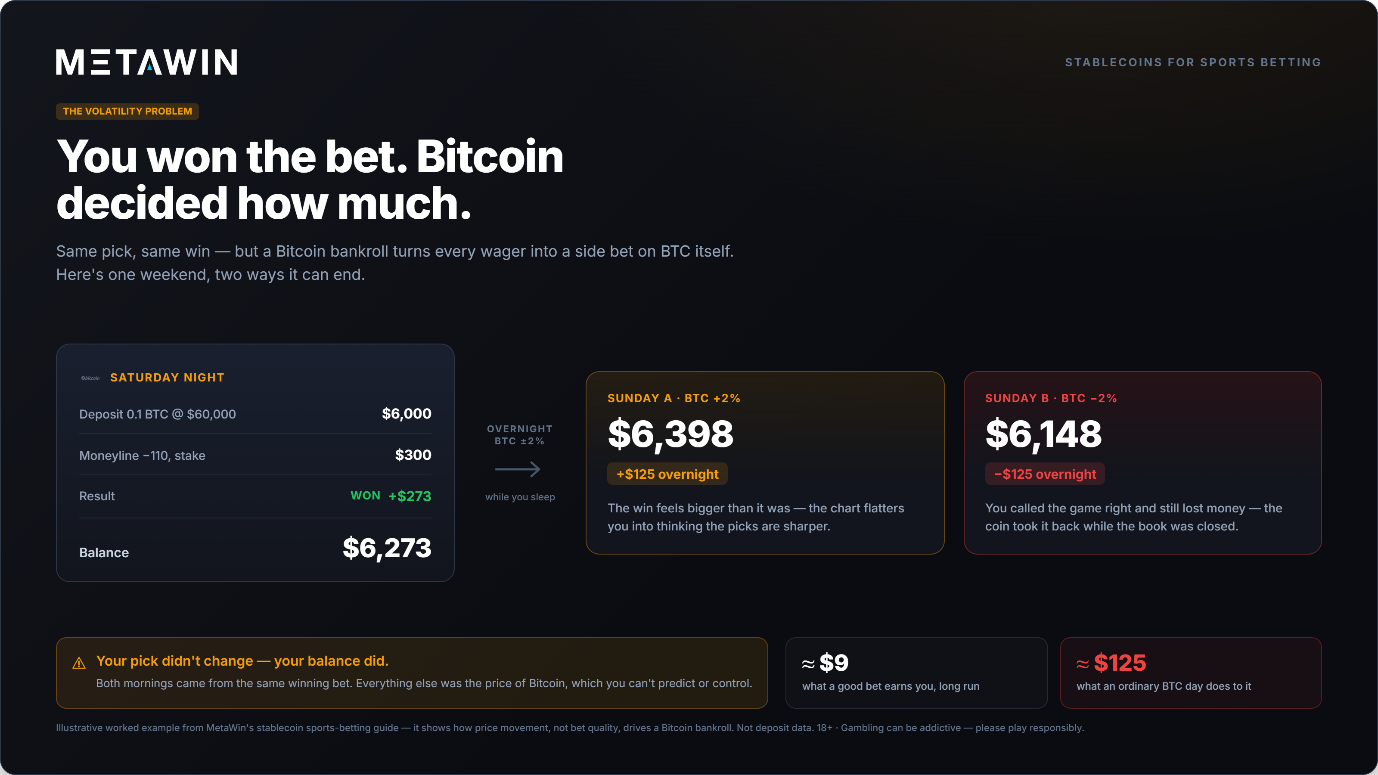
Say you deposit 0.1 BTC with the price at $60,000, which puts $6,000 in your balance. You find a moneyline you like at -110, stake $300, and sweat it home. The book credits you $573, your stake plus $273 in profit, and your balance climbs to $6,273.
Overnight, Bitcoin does what Bitcoin does and moves 2% while you sleep. Your Sunday starts one of two ways:
Morning A, BTC up 2%: Your balance reads about $6,400. The win feels bigger than it was, $273 of handicapping dressed up as $400, and the chart flatters you into thinking the picks are sharper than they are.
Morning B, BTC down 2%: Your balance reads about $6,150. You called the game right and still lost money overnight, because the coin took back $125 of a $273 win while the book was closed.
The difference between those two mornings had nothing to do with your betting, since you made the same pick and won the same money in both. Everything else came from the price of Bitcoin, which you can't predict or control, and which affects far more of your money than the bets do.
A good bet at these odds earns you about $9 over the long run, while an ordinary day of Bitcoin movement changes your balance by about $125.
Keep betting like this for a few weeks or a couple of months, and your balance will mostly tell you where Bitcoin's price went, and the quality of your picks will barely show through.
How stablecoins solve it
Now run the same weekend one more time, with your $6,000 held in USDT instead. A stablecoin is pinned to a normal currency at one to one, almost always the US dollar, and Tether keeps a dollar in reserve for every USDT it issues to hold it there. Park your bankroll in it and three things change:
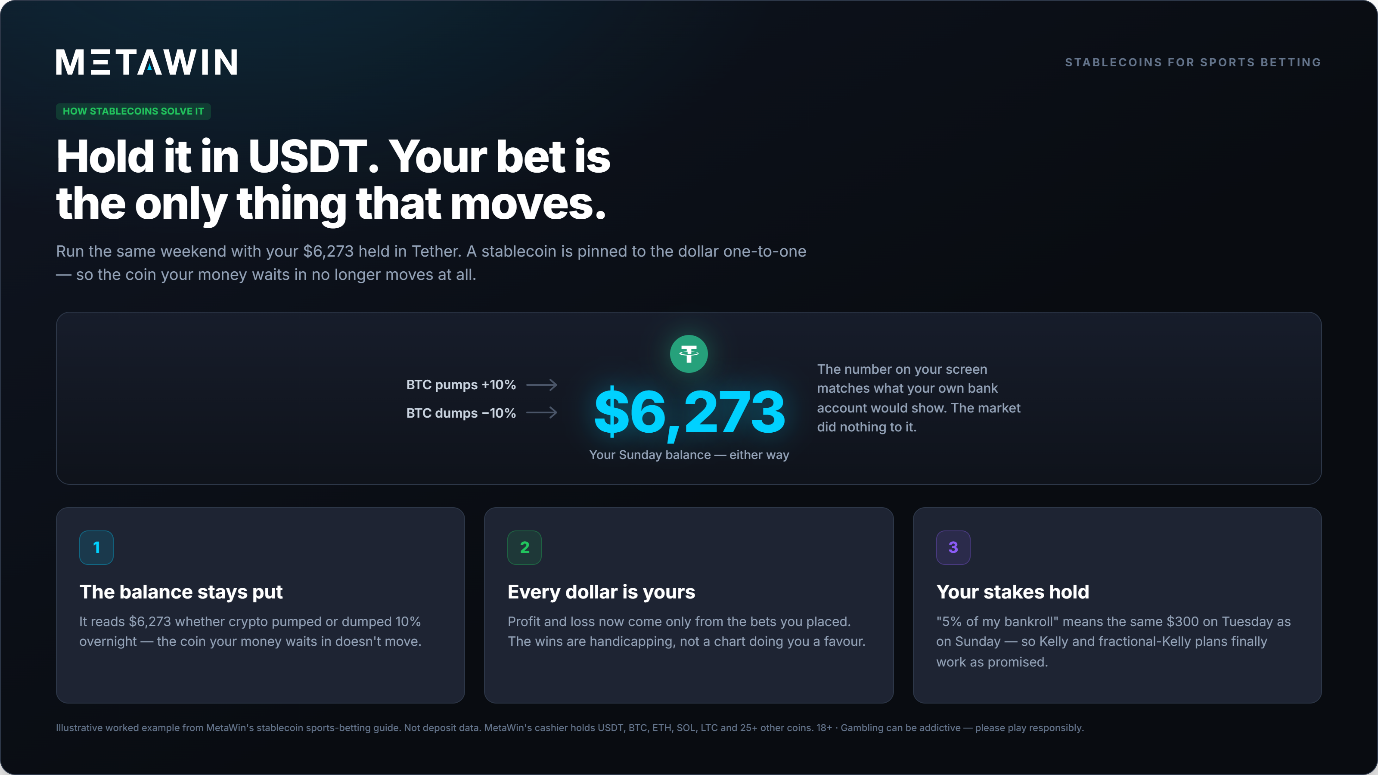
Your Sunday balance reads $6,273, whether Bitcoin pumped 10% or dumped 10% overnight, because the coin your money waits in no longer moves at all.
Every dollar of profit or loss now comes from the bets you placed, so the number on your screen matches what you would see if the bankroll ran through your own bank account.
A stake of "5% of my bankroll" means the same $300 on Tuesday night as it did on Sunday morning, so plans like Kelly and fractional Kelly finally work the way the theory promises.
Sportsbooks reached the same conclusion a while ago, and most US-based crypto books now quote welcome offers and rakeback in dollars, whatever coin the player deposits, because the dollar figure is the one every bettor plans with anyway.
USDT vs USDC vs DAI: which stablecoin?
USDT, USDC, and DAI all hold their dollar, so any of them will do the job. Still, they have real differences in who issues them, how they prove their reserves, which chains carry them, and how many books accept them. Here's what you need to know about each.
Tether (USDT)
For Tether sports betting, USDT is the coin the whole market runs on. Tether holds the largest market cap of any stablecoin, north of $180 billion, and it operates on more chains than any competitor, with native versions on Ethereum, Tron, Solana, Polygon, Avalanche, BSC and others.
Every major crypto sportsbook takes it, and when Tether sports betting sites support only one stablecoin, USDT is that one. MetaWin's cashier carries it too.
For deposits, the Tron version is the pick, since fees cost less than a cent and transfers confirm in under a minute. Nothing else moves a bankroll on and off a book as cheaply or as quickly.
The trade-off is the issuer, because Tether Ltd is a private company and questions about how fully its reserves back the token have followed it for years. The peg has held, but the debate deserves a mention before you park a bankroll there.
USD Coin (USDC)
USDC for sports betting is the buttoned-up alternative. Circle, the company that issues it, has an accounting firm check its reserves every month and publish the results, and its regulatory record runs far cleaner than Tether's, which is why institutions prefer it.
The market cap is smaller, around $73 billion at last count, but the coin runs on most of the same chains, and most crypto sportsbooks accept it.
For a sports bettor, though, the practical difference is close to zero. Deposit USDC and transfers clear at the same speed, the peg holds the same dollar, and your bankroll behaves exactly as it would in USDT.
The only real difference is the company behind the coin. Anyone uncomfortable with Tether's reserve situation can hold USDC and get the same speed, the same peg, and the same betting experience.
DAI and decentralised stablecoins
DAI is the choice for people who want no company involved at all, since nobody holds dollars in a bank to back it.
The coin runs on crypto collateral locked in smart contracts, MakerDAO governs it as a decentralised organisation, and the whole system operates on-chain from end to end. For a Web3-native bettor who already keeps everything in a wallet, that design is the biggest advantage.
However, it has its downsides as well, since fewer sportsbooks accept DAI than USDT or USDC, and the peg has slipped briefly during severe market stress, moments the two fiat-backed giants mostly held their dollar through. DAI earns a spot on your radar, and for most bettors, it works better as a backup than a first choice.
Which chain should you use?
USDT sports betting runs on several chains, and a dollar of the coin holds the same value wherever you keep it. Each chain charges its own fees and clears at its own speed, so the real question is which one should carry your deposits and withdrawals.
If you just want the cheapest, fastest route, Tron is the practical choice. Fees are below a cent, transfers confirm in under a minute, and every book that takes USDT takes the Tron version.
Tron is the right call if:
- You're new to stablecoins and want the option that simply works
- You move money on and off the book often, so fees would pile up anywhere else
- You want a deposit that lands before the odds move
If you already hold crypto on another chain, stay where you are. A bridge or a swap adds a fee and a failure point, and it cancels out whatever the "better" chain would have saved you.
Staying put is the right call if:
- Your funds already live on Solana, which is nearly as cheap and fast as Tron anyway
- You run everything through an Ethereum wallet and accept the higher gas as the cost of one tidy setup
- You hold USDT on Polygon or Avalanche, both fine middle-ground options that most books support
At MetaWin, you can connect a Web3 wallet or deposit USDT straight through the supported chains, so both routes above work here.
When stablecoins are NOT the right choice
Everything above assumed you want zero market exposure, and not every bettor does. If you believe in crypto long term and would hold BTC or ETH anyway, a stablecoin bankroll means opting out of gains you were otherwise positioned for.
A $6,000 BTC balance through a three-month NFL playoff run could reach $7,500 by the Super Bowl on price movement alone, and no betting edge produces that in the same window.
A volatile coin makes sense if:
- You'd be holding BTC or ETH regardless, and the sportsbook balance is just part of that stack
- Your bets run months to settlement; a Super Bowl future placed in September parks that money until February anyway, so it may as well wait in an asset you want to own
- You can wear a losing month that came from the chart, since the same exposure cuts both ways
If none of those fit your situation, then you're still better off with stablecoins.
How to bet with stablecoins at MetaWin
Sports betting with Tether at MetaWin takes a few minutes to set up the first time, and after that it's just how your account works.
- Fund your account: Connect a Web3 wallet like MetaMask or Phantom, or send USDT straight to your deposit address on any chain we support. Before you send anything, check that the chain in your wallet matches the one in the cashier.
- Pick your stake in dollars: Your balance already shows in dollars, so if you bet 5% of your bankroll, you can work that out in your head, and tomorrow it's still the same number.
- Bet on whatever you want: Your USDT works on every market in the sportsbook, moneylines, spreads, props, futures, all of it.
- Withdraw to the same wallet on the same chain: How fast the money arrives depends on the chain. On Tron it takes under a minute, on Ethereum it takes longer.
The cashier also holds BTC, ETH, LTC, SOL and 25+ other coins, so nothing stops you from betting out of USDT and keeping some BTC on the side for the upside.
Did You Know?
Did you know: USDT first overtook Bitcoin as the highest-volume sportsbook deposit method in 2023; the gap has widened every year since, driven almost entirely by bankroll-managed bettors switching from BTC.
Tether on the Tron blockchain is now the single most-transacted stablecoin pair in the world by transfer count, with more daily transactions than any other coin/chain combination.

